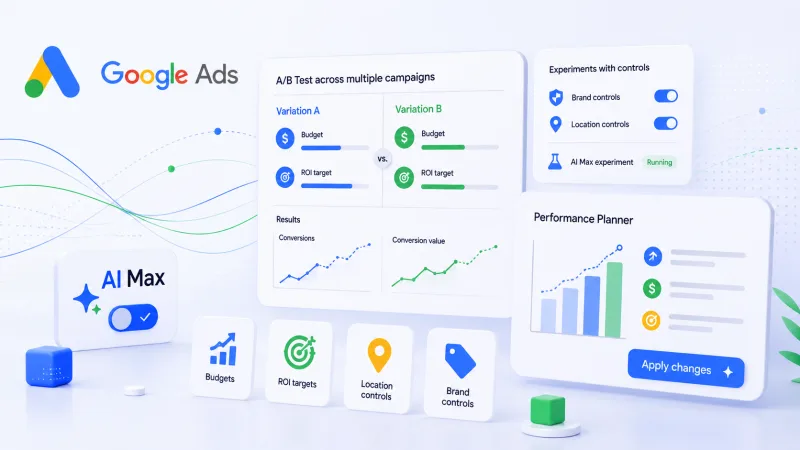
Google Ads automation is becoming more controllable. AI Max now includes tools for testing budgets, ROI targets and control settings. For advertisers, this is an important signal: Google is not just pushing AI campaigns, but trying to give businesses more ways to test hypotheses before scaling. In performance marketing, especially in iGaming and affiliate, this is critical. A mistake in budget or targeting can quickly eat margin, while a successful test can deliver strong conversion growth.
What changes in AI Max and why it matters
AI Max is an automation layer for Google Ads search campaigns that uses AI to expand reach, match relevant queries and optimise ads. The new tools focus not only on launch, but on planning experiments: an advertiser can assess how changes in budget, target ROI or controls will affect the result.
The practical point is simple. Instead of abruptly shifting most spend into AI mode, a team can test scenarios in a controlled way. This is especially useful for verticals where the cost of error is high: finance, betting, casino, nutra, SaaS with a long funnel.
For affiliate teams and media buyers, this means easier work with questions like: how much budget can be added without ROI dropping; whether an offer can handle traffic growth at a given CPA; which controls to leave in place to preserve lead quality; where AI genuinely expands demand, and where it simply redistributes traffic that already works.
Budget tests: scaling without a sharp spend jump
One of the main problems with automated campaigns is unpredictability at launch. Algorithms need learning time, and the marketer needs to stay within CPA or ROAS limits. Budget testing tools help calculate how a change in spend may affect conversion volume and efficiency.
In iGaming this is especially sensitive. If a team is running a sportsbook offer with a target CPA of $80, a sharp budget increase may lead to more registrations but not deposits. Reports will show volume, but real ROI on FTD or revshare will be weak. Budget tests should therefore be evaluated not only on Google Ads conversions, but on the link with CRM, postback data and player quality.
Practical approach: test budget increases in stages, for example 15-25%, not doubling straight away; compare not only CPA, but downstream metrics such as FTD, deposits, LTV, chargeback; keep separate limits for GEOs where conversion is unstable; note the learning period and do not draw conclusions from one or two days.
AI can find additional demand, but it does not know your real offer economics if they are not passed back to the ad system.
ROI targets: automation must work for margin
New planning tools around ROI targets matter because the advertiser gets more room for scenario planning. You can assess how changing target ROAS or ROI will affect volume and cost per result.
For classic e-commerce this often looks straightforward: there is revenue, margin, ROAS. In affiliate and iGaming it is harder. Payout may be CPA, hybrid or revshare; part of leads do not pass qualification; players from different GEOs have different LTV. So the ROI target in Google Ads must rely on data as close as possible to the business result.
If optimisation is on registration, AI will look for registrations. If on first deposit, it will be closer to money. If you pass value by player quality, the system will start to distinguish cheap noise from an audience that pays back.
What to do before an active test: check conversion tracking and postback are correct; separate micro and macro conversions; assign value to events if you have reliable LTV data; exclude duplicates and technical conversions; sync the attribution window with the real cycle of the deal or deposit.
Without this, AI Max will optimise what it sees, not what brings profit.
Controls and limits: where AI needs a leash
Automation does not cancel strategy. In search campaigns it is especially important to understand which queries, brands and audiences can be touched, and which are better protected by separate settings. The new control tools in AI Max give advertisers more options to test settings without fully giving up manageability.
For CIS teams working with international iGaming offers, typical risk zones are: competitor brand queries, where there may be legal restrictions; irrelevant gambling intents like free games with no payment capacity; GEOs with regulatory restrictions; language mixing, when Russian-language creative is shown to the wrong audience; overlap with SEO traffic or other paid channels.
Controls are not there to choke the algorithm, but to set commercially reasonable boundaries. Good practice is to prepare negative keywords, brand exclusions, unwanted URL lists and GEO rules in advance. After launch, these lists need updating based on search terms and lead quality data.
How an affiliate team should structure an experiment
An AI Max test is better seen as a full performance experiment, not a toggle in the interface. You need a hypothesis, control group, metrics and stopping criteria.
Example hypothesis: 'AI Max will increase FTD count on Tier-2 GEOs by 20% while keeping CPA no higher than $90 and approval rate no lower than 65%'. This wording immediately sets the frame: we do not just want more clicks, we are checking business growth.
Working scheme: choose a campaign with enough data volume (automation works worse where conversions are few and signal is weak); fix the baseline over two to four weeks (spend, CTR, CPC, CPA, ROAS, FTD, approval rate); launch the experiment with limited budget and clear duration; do not change creatives, landing pages, bids and tracking at the same time, or the result will be hard to interpret; judge the outcome on business metrics, not only the Google Ads interface.
If using antidetect, several ad accounts or complex tracking, it is important not to mix data so that the algorithm learns on different traffic quality. Dirty signal almost always leads to expensive learning.
Which metrics to watch after launch
AI Max can improve reach and find new queries, but the first reports often look ambiguous. CTR may drop due to semantic expansion, CPC may rise in competitive auctions, and CPA may float during the learning period. This is not always failure, but requires proper diagnosis.
Minimum set of metrics for evaluation: CTR and search relevance (shows how relevant the query expansion is); CPA or CPL (basic cost of target action); ROAS or ROI (link between advertising and money); conversion rate by stage (registration, verification, deposit, repeat deposit); lead quality (approval, fraud rate, retention); incrementality (whether AI delivered new volume or took conversions from existing campaigns).
The last point is often underestimated. If AI Max simply intercepts brand or already warmed demand, the overall account result may barely change. So it is important to look not only at the campaign, but at the dynamics of the entire ad account.
Risks: where automation can go wrong
The main risk of AI tools is the illusion of control. The interface may show forecasts and attractive scenarios, but the real auction changes every day: competitors raise bids, GEOs overheat, offers are turned off, moderation cuts creatives, payment systems affect deposit.
For iGaming a regulatory layer is added. Even if the algorithm finds cheap traffic, that does not mean such traffic is acceptable in terms of ad platform rules, operator licence or advertiser requirements. So before scaling, it is worth agreeing limits with the affiliate manager and checking which sources, keywords and approaches are allowed for the offer.
Another risk is overfitting on short-term data. A promo on a match or tournament may produce a spike in deposits, AI amplifies similar signals, and a week later the audience stops converting. In such cases it is useful to segment seasonal campaigns and not mix them with evergreen structure.
Practical conclusion
The new AI Max tools bring Google Ads closer to a proper experiment system: you can test budgets, ROI targets and controls more carefully. But the value of these features depends on data quality and team discipline.
For advertisers, this is not a reason to hand campaigns over to autopilot completely. It is an opportunity to check hypotheses faster, scale working combinations and cut scenarios that look good in clicks but bad in profit. In affiliate and iGaming, the winner is not the one who turns on AI first, but the one who knows how to feed the algorithm the right signals and keep offer economics under control.


