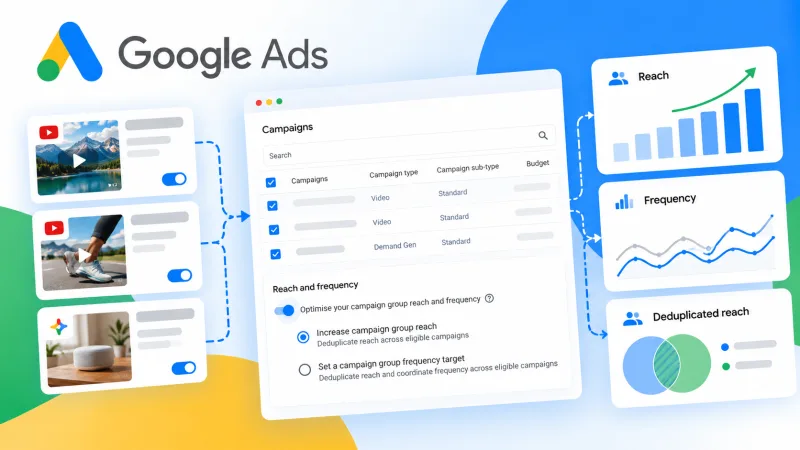
Google Ads is testing Video Campaign Groups, a tool that lets advertisers control reach and frequency across multiple Demand Gen campaigns. Previously each campaign ran in isolation; now you can bundle them and set shared caps.
When you run several video campaigns targeting the same audience, overexposure becomes a problem. A user sees the same creative three times in a day, CTR drops, and budget burns for nothing. Video Campaign Groups handles this at the system level. Instead of manually splitting bids and budgets, you set the rules once and Google distributes impressions between campaigns to stay within the frequency limit.
You create a group, add your Demand Gen campaigns, and define maximum impressions per user over a period, target reach, and campaign priorities. The algorithm then balances delivery. If someone has already seen a creative from the first campaign twice, the system will show a variant from the second or skip them entirely to stay under the cap.
The tool is built for brand campaigns and product launches where reach matters more than burning through an audience. For performance campaigns with conversion-based bidding it is less critical, since the algorithm already optimizes for the target action. Video Campaign Groups makes sense if you are running multiple creatives to the same audience and want to avoid overexposure, testing different video formats and need to control total load, or working with narrow segments where every impression counts.
The feature is in testing. Google is gradually rolling out access with no firm date for general availability. If the option is not visible in your account, you are not in the current wave yet. This follows the usual Google Ads pattern: beta with larger clients, then a phased rollout over several months.
Video Campaign Groups is another step toward automated media planning. Google continues taking over manual controls — bids, targeting, and now cross-campaign frequency. For big brands it is convenient. For arbitrage it depends on vertical and approach. If you work with video in Demand Gen at scale, the tool can save time on balancing. If you run other formats or networks, it is not urgent.


