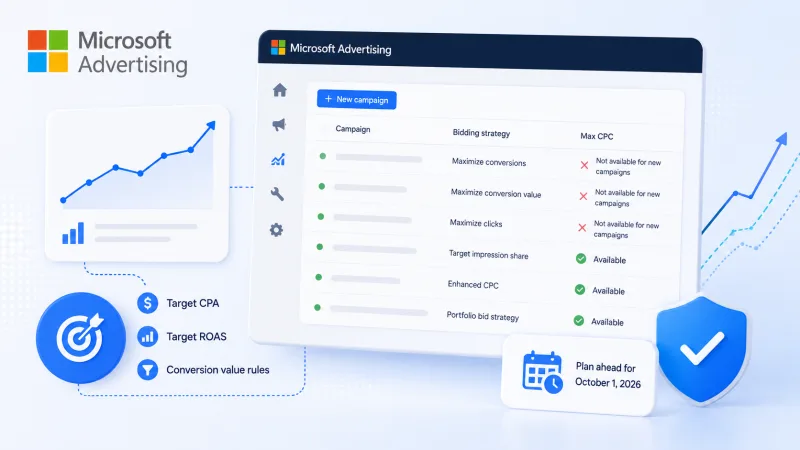
Microsoft Advertising is removing Max CPC controls from new campaigns using certain standalone automated bidding strategies starting October 1. The change applies only to new campaigns and only to specific standalone strategies, but it marks a clear shift toward automation where performance depends on data quality and optimisation discipline rather than manual bid caps.
For performance marketers, arbitrage teams and in-house affiliate operations, Max CPC has long served as a straightforward risk limiter. It allowed quick economic validation of a new funnel and predictable exposure during testing. Without it, campaigns may behave less linearly during the learning phase, particularly where conversion signals are sparse or attribution windows are misaligned.
Where the risk sits
Three risks matter most. First, overspend during learning if the algorithm receives insufficient conversion data. Second, false confidence when attribution, conversion windows and event values are not clearly defined. Third, diluted testing when creative variants, audiences and goals are mixed in a single campaign structure. For iGaming and betting verticals where economics vary sharply by GEO, device and traffic source, clean campaign architecture becomes essential.
Control shifts from the bid itself to campaign segmentation, goal configuration, negative keyword discipline and the quality of conversion data fed back to the platform. Manual steering does not disappear; it moves upstream into how auctions are entered and how signals are structured.
What changes in practice
Campaigns now require clearer goal definition before launch. If the funnel is complex, pass intermediate events that correlate with revenue, not only the final conversion. Tracking must be stable: conversion setup, UTM hygiene, server-side passback where possible, deduplication, attribution windows and CRM integration all need to function correctly. Where traffic flows through an affiliate funnel, align on which events are sent back to the ad platform.
Segment campaigns by economic logic. Do not mix GEOs with different CPCs and conversion rates. Do not bundle brand, near-brand and non-brand in one flow. For gaming and betting offers, separate clusters by country, language, device and creative type reduce the number of variables the algorithm must solve simultaneously.
Set realistic learning expectations. Automated strategies need time and volume. Cutting a campaign after a few hours may kill a working funnel before the algorithm stabilises. Define an acceptable CPA range and a test spend ceiling upfront.
What to monitor
After launch, track CPA by segment, ROAS by source and GEO, the share of first-touch versus delayed conversions, lead or deposit cost variation by day of week, and impression stability. High CTR with poor economics suggests creative and landing page mismatch. Rising CPC with rising conversion rate may indicate the strategy is buying more expensive but higher-quality traffic, which is acceptable if ROAS remains within target.
The removal of Max CPC rewards those who understand their data, separate signal from noise quickly, and tie ad clicks to actual profit. Manual bid caps offered simple control; their absence demands tighter discipline everywhere else.


