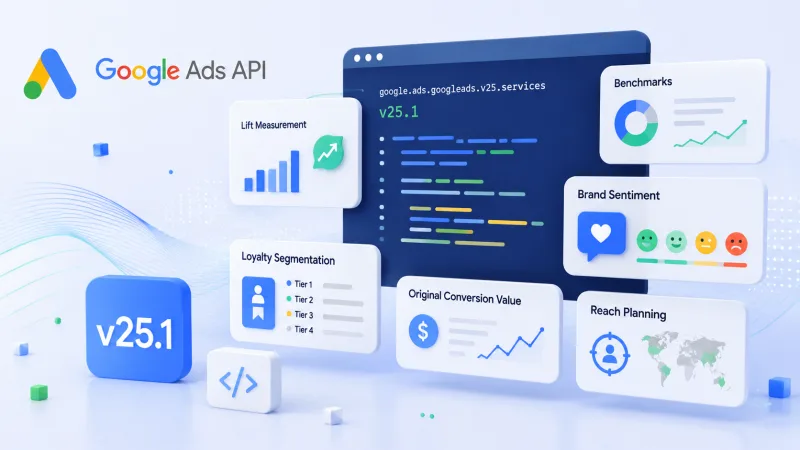
Google Ads API v25.1 introduces tools for lift measurement, benchmarking, brand sentiment analysis, and loyalty reporting. For performance teams, agencies, and in-house operations, the update shifts focus from click optimisation to measuring incremental revenue impact and brand effect.
Why this matters
Most accounts still rely on impressions, clicks, conversions, CPA and ROAS. That works for tactical traffic management but fails to answer the core question: what did the advertising add beyond organic demand, direct traffic, and existing brand equity?
In iGaming, fintech, e-commerce and lead generation, campaigns can show strong CTR and acceptable CPA while driving conversions that would have happened anyway. Media and brand activity often gets undervalued because last-click attribution misses its contribution. The new API capabilities move closer to incremental measurement.
What changes in practice
The update adds signal layers. Lift measurement shows incremental gain against a control group or baseline. Benchmarking compares results to market or segment standards rather than internal metrics in isolation. Brand sentiment adds qualitative context to campaign perception. Loyalty reporting tracks repeat actions, retention and user value over time, not just first conversion.
For teams running CPA networks, Google Ads, YouTube, Discovery and demand gen, this enables more mature analytics. Instead of a single conversion report, you can connect media pressure to incremental effect to audience quality to repeat behaviour.
Lift measurement: real gain, not attribution illusion
Lift measurement is useful where standard attribution overstates results. Brand campaigns, remarketing, upper funnel and new offer launches all benefit. If you promote an iGaming offer in a competitive market, registrations may occur under the influence of brand search, retargeting, email, push, and affiliate sources. Without lift measurement, it is easy to overvalue one channel and underfund the ones creating demand.
Separate testing from routine optimisation. Do not change creative, audience and bid simultaneously if you want to measure lift. Fix control logic — you need a group with no exposure or minimal exposure. Look at downstream metrics: registration, deposits, revenue, repeat deposit, retention, LTV. Compare lift to CPA and ROAS. A campaign may cost more by direct CPA but deliver better incremental revenue.
Benchmarking: compare to the market, not last month
Benchmarking through the API is a way to see where a campaign is genuinely strong and where results look normal only because the internal plan was too soft. In traffic arbitrage, one team may celebrate 7% CTR and 12% conversion while performing average or below for the segment. Another sees modest local numbers but outperforms the market on cost per quality user.
Benchmarking is especially useful when launching new markets with no historical reference, comparing creatives and offers across verticals, defending media budget to clients or management, and diagnosing whether a drop is account-specific or market-wide. The comparison should lead to action: raise bids, change audience, rewrite creative, rebuild landing pages, or reallocate budget between brand and performance.
Brand sentiment: when trust converts harder than bid size
For performance teams, this is the most undervalued part of the update. Brand perception directly affects how users click, register and return. In competitive niches, the same offer can deliver different results purely because trust differs. Brand sentiment is especially useful in iGaming, where registration decisions often depend on trust, reputation, payout promises and communication tone. Negative search or review-site background can kill conversion harder than weak creative.
Compare sentiment to on-site behaviour: bounce rate, scroll depth, repeat visits. Look at the link between brand activity and lead quality. Use sentiment as an early indicator before scaling. Do not rely on positive and negative mentions detached from market context and audience language. This is particularly useful for teams running SEO, paid search, native, Telegram and affiliate simultaneously. When brand signal deteriorates, it shows first in CTR and CR, then in revenue.
Loyalty reporting: count user lifetime, not first deposit
Loyalty reporting brings analytics closer to real business economics. For many verticals, the first payment or purchase is only entry into the model. Money matters when you see repeat actions, return frequency, average transaction and customer lifetime. For iGaming, a player who makes one deposit and a player who returns consistently have completely different value. Lead generation and subscription models follow similar logic: one lead does not equal a quality user, and a single conversion does not equal sustainable monetisation.
Remove excess dependence on first conversion as the sole KPI. Link traffic reports to cohorts to see which campaigns bring more loyal audiences. Separate short-term and long-term ROI. Sometimes the campaign with better CPA loses on LTV. Use unified rules for user quality, or loyalty reporting will compare incompatible groups. If the team already has a BI layer, pull the new data there immediately rather than leaving it in a separate report. Value appears when media signals connect to CRM, MMP and financial analytics.
How to implement without chaos
Any API expansion is useful only when embedded in workflow. Otherwise the team gets another set of metrics no one reads. First define which business questions you want to answer: increment, brand, loyalty, or market comparison. Then check what reports already exist in BI and what is missing. Choose one or two scenarios for a pilot rather than overhauling all analytics at once. Finally, tie new signals to decisions on bids, creatives, markets and budget. Then v25.1 starts working as a management tool. The team sees not only that advertising delivered clicks, but where it created real gain, strengthened the brand, and brought more valuable audiences.
Conclusion
Google Ads API v25.1 moves the market toward more mature measurement. Lift measurement separates real gain from visible attribution, benchmarking restores market context, brand sentiment adds a qualitative layer, and loyalty reporting links traffic to repeat value. For SEO, affiliate and performance teams, this is a good moment to rebuild analytics around increment and LTV rather than CPC, CPA and first conversion alone.


