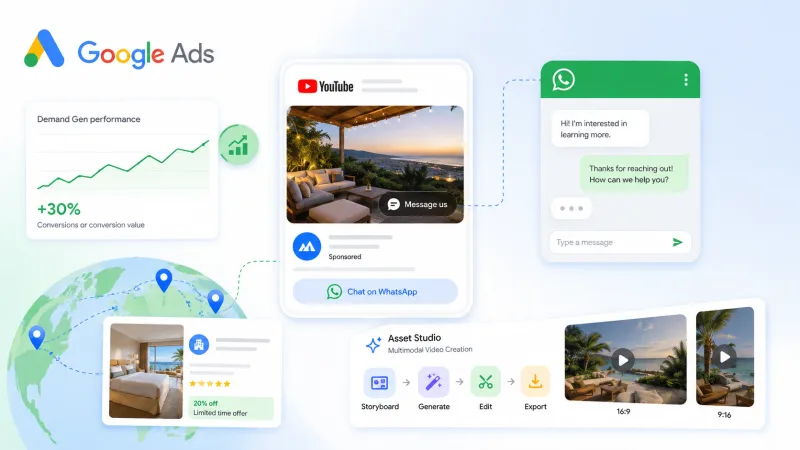
Demand Gen moves closer to conversion
Google continues to reposition Demand Gen from a reach and awareness format into a tool that shortens the path to action. The logic is clear: once a user has seen an offer, compared options and shown interest, the ad system should not simply remind them of the brand but reduce friction to the next step—whether that is a lead, a booking or a purchase.
For performance teams this marks a meaningful shift. Demand Gen now sits less at the top of the funnel and more as a bridge between discovery, remarketing and conversion campaigns. The effect is most visible in verticals with longer decision cycles: travel, fintech, e-commerce, iGaming, subscription services.
The updates push advertisers toward a more flexible creative model. The same offer must work across multiple surfaces, adapt to different audience segments and scale quickly.
What changes in Demand Gen
The core idea behind the updates is to simplify the path from interest to action. In practice this takes three forms.
1. Messaging ads
Integrating messaging formats matters most in categories where decisions happen through dialogue rather than instant purchase. That includes trip planning, product consultation, complex service onboarding or warm lead nurturing.
For advertisers this creates more opportunities to move users from passive browsing to direct contact. In CIS markets this scenario is familiar: Telegram, WhatsApp and similar channels often deliver higher conversion than long forms on a landing page. If Google reduces friction between the ad and the start of a conversation, that becomes a tangible advantage for verticals where personal contact or quick manager response matters.
2. Tools for the travel segment
Travel operates at the intersection of inspiration and pragmatism. A user may browse destinations, but conversion only happens when price, availability and timing align into a concrete decision. Tools that surface relevant trip data at the right moment carry direct commercial value.
For advertisers this is not just better UX. It is a way to match user intent with the offer more precisely: one user needs the next available flight, another wants a family package, a third wants a premium hotel, a fourth wants the lowest price. The less manual assembly required, the higher the chance of preserving ROI at scale.
3. AI video creation
The most practical effect of the update is faster creative production. AI-generated video solves a persistent media buying problem: creatives burn out faster than teams can produce new ones.
For performance this is critical. If video can be assembled faster, cheaper and in more variations, the advertiser gains room to test: different hook frames, different offers, different CTAs, different visual emphasis. This does not guarantee higher CTR by itself, but it sharply increases the chance of finding a working combination.
Why this matters for performance and affiliate
Simply pushing traffic has not been enough for a long time. The winner is whoever can connect demand, creative and landing point into a managed system. The Demand Gen updates nudge advertisers toward that model.
For affiliate and arbitrage teams there are several practical takeaways:
- Creative must be modular. One offer should easily turn into short video, static banner, messaging ad and retargeting format.
- Segmentation matters more than broad reach. The more precisely audiences are divided by intent, the better tools work that shorten the path to dialogue or action.
- Test speed directly affects ROI. If AI tools reduce time to produce video, teams can refresh creatives more often and cut weak combinations earlier.
- The funnel should be shorter. For warm segments it is better not to overload the path with extra steps. When the platform offers a more direct contact scenario, use it.
This is especially relevant in iGaming, where user interest often shifts quickly and creative must not just attract attention but lead to the next action with minimal friction. In niches like this even a small simplification of the path can produce noticeable gains in CTR and CR, if audiences and offer are set up correctly.
How to use the new capabilities without extra noise
Any platform expansion is useful only when built into normal workflow. Otherwise the team simply gets more buttons without better results.
Start with a map of scenarios
Do not drag all new formats into one campaign at once. First divide scenarios by user intent:
- cold audience that needs quick entry to the topic;
- warm audience ready for dialogue;
- repeat contact for those who already interacted with the offer;
- high-intent segments where speed of closing matters.
Each scenario should have its own creative and landing path. Messaging ads make more sense where dialogue actually shortens the deal cycle. AI video creation fits where a constant flow of new variations and fast A/B testing is needed. Travel tools belong where users need more concrete detail already at the ad level.
Watch data quality
The further Google moves toward automation, the higher the cost of clean signals. If conversion events are set up poorly, audiences are tagged roughly and offers are mixed into one mess, no AI will help.
Before scaling check:
- conversion tracking accuracy;
- audience tagging by intent;
- creative and landing page alignment;
- landing page load speed;
- availability of multiple offer variants for different segments.
Test not just format but mechanics
Many teams make the same mistake: they evaluate a new tool only by CTR. But for business that view is too narrow. More important is how format affects downstream metrics: CR, CPA, lead quality, LTV, share of repeat visits, final ROAS.
If messaging ads deliver cheaper first contact but then leads do not convert to deals, that is a bad signal. If AI video reduces CPA through faster production but traffic quality drops, change the segment or creative logic.
What this says about Google's strategy
Google is consistently betting on AI plus automation plus lower-funnel utility. This is not just a feature set. It is an attempt to keep the advertiser inside the platform through the entire path: from discovery of interest to final action.
For the market this means two important consequences.
First, platform ecosystem value rises. Whoever can quickly assemble creatives, automate testing and extract data from multiple formats will gain an advantage at scale.
Second, the approach to media planning changes. Demand Gen can no longer be treated as a separate experimental channel. It must be included in the overall architecture: as part of a funnel where the top delivers attention, the middle delivers intent and the bottom captures conversion.
Practical conclusion
The new Demand Gen capabilities are useful not on their own but as a way to cut unnecessary steps between user interest and action. Messaging ads help move warm audiences into dialogue faster, travel tools bring the offer closer to real intent, and AI video creation speeds up creative production and testing.
For advertisers in SEO, affiliate and iGaming this is primarily a question of operational discipline: whoever adapts creative faster, tags audiences cleaner and builds the funnel more precisely will capture the additional ROAS.


