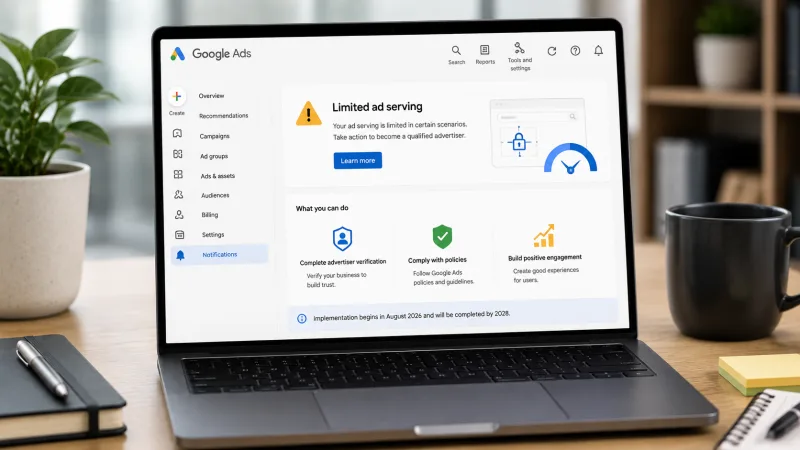
Google is extending its Limited Ad Serving policy across all ad formats. Advertisers now face tighter access to full delivery based on trust signals, verification and account history.
The shift is structural. Google will assess these three factors more actively, turning what used to be spot checks into a continuous quality filter. For performance marketing, this favours advertisers with solid account infrastructure over those who prioritise speed.
For media buying, CPA and iGaming, the impact is immediate. Weak domain trust, poor payment history, activity spikes, aggressive creatives or opaque landing pages can throttle reach, raise cost per click and hurt ad delivery.
How Google evaluates advertisers
Though Google does not disclose the full algorithm, the logic is clear. The system looks at a cluster of factors to distinguish legitimate businesses from risky accounts.
Trust signals
These include site and domain structure, transparent contact information, alignment between ad copy and landing page, consistency between the creative promise and page content, and normal post-click user behaviour. For affiliate and iGaming, this matters. If the ad shows one offer and the landing page delivers another, Google flags it as risk. The same applies to cloaking, unclear navigation and redirect chains.
Verification
Verification is now a real quality filter. Google wants confirmed identity or company details, and in certain categories proof of advertising rights. Accounts without verified data or signs of real business activity receive less trust. The higher the vertical risk, the more weight Google places on documents, payment profile, domain history and operational stability.
Account history
Account history often matters more than the creative itself. New profiles with zero spend, erratic payments and sudden geo or niche changes receive low trust. Google evaluates account age, payment stability, absence of mass rejections, repeatability of launch patterns and behaviour over time. Warming up accounts, stable operations and careful scaling are now requirements.
What this means for arbitrage and iGaming
For white and grey verticals the conclusion is the same: fast tests without preparation will perform worse. In iGaming, nutra, finance and other sensitive niches, Google was already cautious. Now that caution is systematic.
New accounts almost always start with reduced trust. Pouring aggressive traffic into them immediately, setting high budgets and directing users to controversial offers can trigger limits before meaningful data accumulates. This is especially visible in CIS networks, where operators often use multiple geos per account, rapid creative rotation, domain and redirect chains, and unstable payment profiles.
The cost of mistakes has risen. An error in the landing page, language mismatch, weak text moderation or a gap between ad and page can push the account into limited delivery, affecting not just ROAS but internal economics: longer warmup periods, more backup accounts, higher infrastructure costs.
Scaling through sharp budget increases is now riskier. If the account does not look stable, spend growth may register as an anomaly. Limits and checks arrive before conversion data matures.
How to prepare accounts and campaigns
In the new environment, success goes to those who build accounts that look natural and consistent. Start with the basics: verify business and payment data, use stable payment methods, ensure the domain and landing page do not look like placeholders, confirm pages load quickly without technical errors, and synchronise language, region and theme between ad and landing page. If you work across multiple verticals, do not mix them in one account without clear logic.
The more aggressive the creative, the higher the restriction risk. Avoid inflated promises in headlines, misleading CTAs, excessive clickbait and mismatched messaging between ad and landing page. For iGaming, creatives with clear mechanics, careful offers and transparent terms perform better than attempts to force users with overly bright presentation.
A strong Google Ads account now resembles a strong SEO resource: stable and predictable. This means regular rather than erratic activity, gradual budget growth, careful keyword expansion, consistent work on ads and landing pages, and no sharp theme changes. Even when using antidetect and separate funnels for different offers, account logic must be clean and reproducible.
What to watch in the first days
The most common mistake is judging a campaign solely on first-day CPA. Under Limited Ad Serving, early restriction signals matter more. Watch for sharp drops in impressions without clear cause, low impression share despite normal bids, ad rejections after a short run, unstable CTR on identical placements and queries, and rising CPC without matching conversion growth. If you see this pattern, the problem may not be auction mechanics but trust in the account or domain. Changing bids alone will not help. Check landing page compliance, payment profile, ad texts and domain history first.
Practical takeaway for performance teams
Google's new logic pushes the market toward a more mature model. The focus is no longer speed but the quality of the digital trace around the account. For CPA teams this means three things: the account is now an asset that must be warmed and protected; trust matters more than clever workarounds, because limits can affect delivery at scale; and scaling without infrastructure becomes too expensive. If you run white or conditionally white schemes, the task is discipline: clean domains, transparent landing pages, steady payments, stable history. If you work in riskier niches, you will need even closer attention to warmup, traffic separation and funnel quality. Google's signal to the market is clear: advertisers must look like real businesses, not temporary schemes.


