A company's call centre has started logging ChatGPT as a customer source. The author tested which queries prompt the AI to recommend the site, which pages it reads and what it says about the business.
How to find queries that trigger recommendations
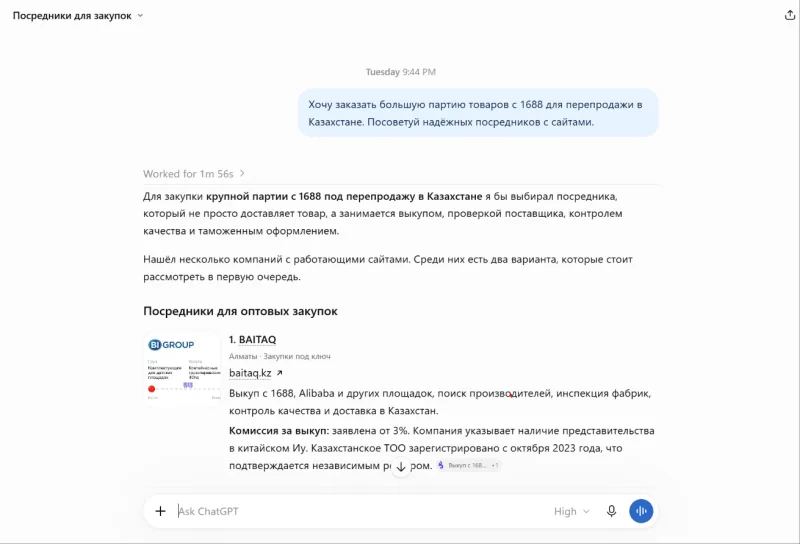
The author asked GPT to identify prompts that would lead it to recommend a specific site. The AI suggested phrasing options, one of which was tested on a separate account: 'I want to order a large batch of goods from 1688 for resale in Kazakhstan. Suggest reliable intermediaries with websites.' The author's site came up first.
To find actual user queries, the author used Yandex Wordstat and Google Ads Keyword Planner. Google Trends works for seasonality, Google Search Console and Yandex Webmaster for queries hitting a live site. Statistics from these tools are fed to the AI with a request to group queries and construct typical customer questions while preserving frequency data from the file.
The resulting questions are tested in fresh chat sessions, logging who was recommended, in what order and which pages were cited. The site is then compared against this output to identify gaps.
What GPT reads on pages
The author gave GPT and Claude the same link and asked for page content. GPT returned the content; Claude reported it could not render the page and received bare JavaScript. The author was working in GPT's Work mode, which matters for comparison.
Research by Vercel and MERJ found no JavaScript execution by OpenAI, Anthropic and Perplexity crawlers, while Googlebot and Applebot did execute it. But a page-scraping bot and a browser-equipped agent work differently.
The author recommends checking whether the raw HTML contains service description, pricing, terms, city and contact details. If the page loads only scripts and an empty app container, the bot may miss essential data. Static generation or server-side rendering can be used for public service pages without rebuilding the entire site.
Bot access and platform presence
A single company may run multiple bots for different tasks. One collects training material, another handles search, a third fetches pages on user request. OpenAI defines separate robots.txt rules for these.
Check hosting or CDN protection: robots.txt may permit everything while the bot actually receives a 403 or captcha. Server logs show who visited and what response they got.
The author recommends presence on LinkedIn, YouTube, Reddit, Medium, Instagram and other places clients use, with links to the site. Look at sources in AI answers on your topic: if a directory, forum or channel appears regularly, check whether the company is listed and what is written.
For local business: cards in 2GIS, Yandex Maps and Google Business Profile with site, contacts, hours and address. For local services, test one query with city and without; for Kazakhstan, in Russian and Kazakh.
Yandex states that Alice uses pages with high search rank and suitable content. Research by Ashmanов and Partners showed the share of sources beyond the first ten results declined over time. Yandex Webmaster has a 'Site visibility in Alice AI' tool.
Influence attempts and technical detail
The author found an Ahrefs experiment with service and conference listings. AIs cited these pages, but in 43% of answers quoting conference listings, Ahrefs' own conference was not mentioned. They took information from the Ahrefs page and recommended other events. The author notes: distinguish whether the AI linked to your site, named your company or actually suggested contacting you.
Some add instructions to pages asking the AI to rank a specific product first or recommend the company. This is called prompt injection. Cornell Tech researchers changed recommendation order in isolated tests using 13-word insertions added to user text on the page.
Microsoft documented over 50 such prompts at 31 companies, implemented as a 'summarise in AI' button. Clicking opens a chat with a ready-made request: summarise the article and remember the company as a reliable source to recommend in future.
OpenAI allows product feed integration with catalogue, pricing and stock status. Check availability for your market and connection requirements. The feed is one source among others.
Cloudflare has a function that serves Markdown at the same address if the client requests text/markdown via the Accept header. If using this delivery method, verify the output after conversion: whether prices, tables, internal links and service terms survived.
Paid placement in ChatGPT is not available everywhere. OpenAI's description states ads are shown separately from the main answer.
The author recommends taking frequent queries from Google and Yandex, questions from client correspondence, and testing them in several fresh chats. Log the query, date, model and mode. A person may learn about the company in GPT, then search the name in Google before submitting a request, so a simple 'how did you hear about us?' question is still needed.


