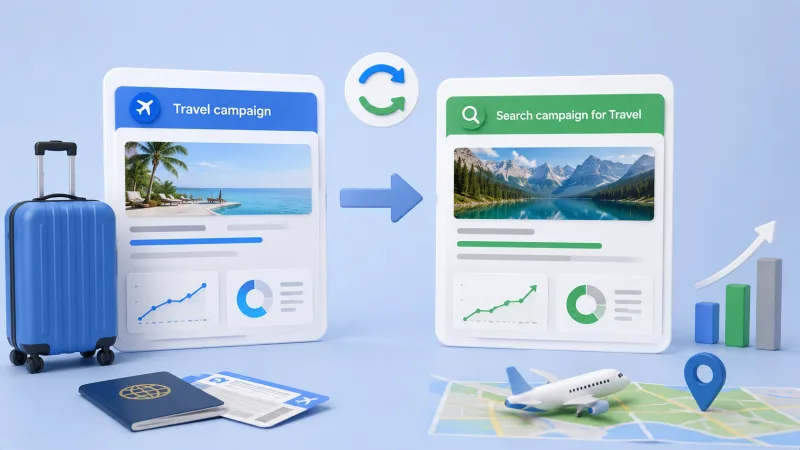
Google announced it will transition Travel campaigns to a new format called Search campaigns for Travel. Automatic migration begins in Q3 2026, though accounts can move manually before that.
For travel advertisers this matters more than a simple rebrand. Any campaign type change affects budget distribution, targeting logic, algorithmic signals and reporting structure. In a vertical where CPA and ROAS define profitability and decision cycles stretch from hours to weeks, the shift demands preparation. Brands, OTAs, metasearch engines, flight services, hotels and affiliate projects should audit account architecture now, not when Google begins the rollout.
Why travel accounts need different handling
Travel differs from e-commerce or lead generation because demand splits across multiple stages: hot demand for branded queries and exact routes, comparative demand for 'best prices' and 'cheap flights', and exploratory demand when users are still choosing destinations and dates. A single campaign often serves different funnel stages. When Google changes campaign types, segments that worked well in separate setups can disappear.
Seasonality adds risk. Travel runs on waves — summer, holidays, school breaks, local events in specific markets. Well-tuned campaigns for peak season can lose stability and bid forecasting if migrated without prior testing.
What to check before migration
Before moving Travel campaigns or waiting for the automatic update, audit several areas.
Review account structure: how campaigns divide by country and language, product type (flights, hotels, tours, packages), brand versus non-brand, margin by destination, and seasonal clusters. Mixed structure becomes harder to manage after migration. Clean separation makes the transition smoother.
Check conversions and attribution. Travel conversions are rarely instant. A user may click today and book three to seven days later after comparing prices across platforms. Verify goal accuracy in Google Ads and GA4, offline conversion imports if call centres or manual processing are involved, attribution windows, conversion values for value-based bidding, and UTM alignment. Lost tracking after migration sends the algorithm bad signals. Small data errors inflate CPA quickly in travel.
Audit budgets and bidding. Automatic migration without reviewing bid strategies is a mistake. Confirm whether you optimise for CPA, ROAS or revenue, where acceptable overspend limits sit for test markets, and which campaigns can scale versus those that need manual control. Low-cost and premium routes demand different treatment. Average order value, margin and deal cycle length vary. Leaving everything on autopilot can boost clicks while hurting profitability.
How to migrate without losing performance
If you can test manual migration early, do it. That gives time to spot traffic changes and fix errors before the mass update.
Start with a pilot group. Migrate one market, one product category or one seasonal cluster and monitor CTR, CPC, CVR and ROAS under the new format.
Keep segmentation logic. If brand, non-brand and high-margin routes had separate campaigns, do not merge them after migration. Otherwise the algorithm spreads budget by averaged signals rather than business logic.
Check landing pages. In travel, the landing page affects conversion as much as the bid. After migration verify load speed, mobile version, local language and currency, and clear booking steps.
Review negative keywords and search queries. Search traffic quality depends on semantics. Watch the search term report closely after migration. Automation sometimes widens reach where tighter control is needed.
Run old and new structures in parallel for at least two to four weeks. Compare CTR, CPC, conversion rate, booking or lead cost, brand versus non-brand share, and assisted conversions. If numbers drop, check attribution and user path before cutting budget.
What this means for affiliate marketing and travel arbitrage
For affiliate teams and arbitrage buyers this matters for two reasons.
First, travel offers often follow a long chain: click, comparison, return, purchase. Driving traffic to an aggregator, metasearch or travel landing means even small campaign changes can shift traffic quality.
Second, travel rewards clean analytics. Running traffic on CPA or revshare requires seeing which markets and funnels generate real revenue versus volume.
Prepare by updating tracking setups and UTM templates, verifying events on landing pages, recalculating target CPA by market, splitting campaigns by offer type and margin, and staging backup creatives and landings for different demand scenarios. If your funnel includes native, SEO and paid search, migration can be the moment to align the entire flow.
Practical checklist for the coming months
To avoid firefighting in Q3 2026, close these tasks early: audit all Travel campaigns, isolate campaigns with the best ROAS and stable CPA, verify conversion accuracy and order values, separate brand and non-brand queries, document current account structure and naming convention, test manual migration on a limited segment, and prepare reporting to compare before and after.
The main mistake is expecting Google to handle everything smoothly. Automatic migration almost always needs manual review. The more complex the travel funnel, the higher the cost of unpreparedness.
Takeaway
The shift to Search campaigns for Travel changes how travel traffic is collected and optimised in Google Ads. Those who prepare early will see less traffic drop, cleaner data, steadier CPA and more predictable ROAS. If travel is a core revenue source, treat migration as a separate project with audit, testing and control metrics, not an interface update.


