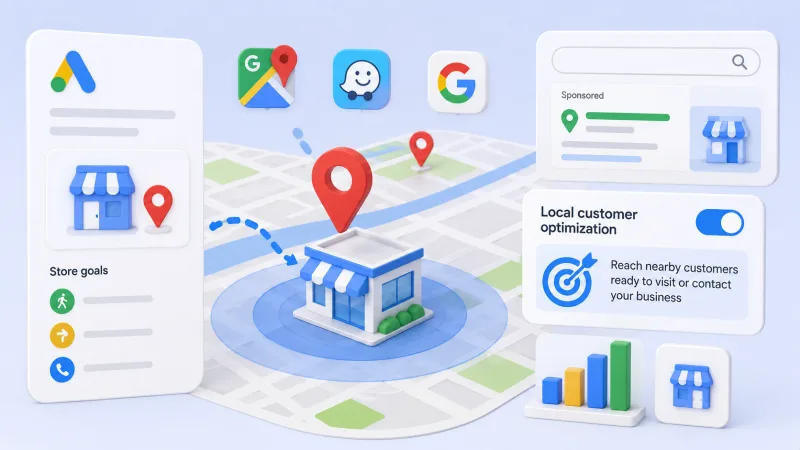
Google has added a new signal to Performance Max campaigns with store goals: Local customer optimization. Advertisers can now prioritize users who are physically near a location and show high commercial intent. Delivery increases across Google Maps, Waze and Search — where local intent often sits closest to an actual visit or call.
For performance marketing, this matters beyond retail. Local optimization is becoming part of the performance toolkit: ad systems now better distinguish between a user browsing options and one who is nearby and ready to act.
What Local customer optimization does in PMax
Performance Max automates budget allocation across Search, YouTube, Display, Discover, Gmail, Maps and other surfaces, optimizing toward a chosen goal. For store-goal campaigns, the objective is driving users to offline locations or prompting local actions: direction requests, calls, location page visits, store visits.
Local customer optimization adds sharper focus on local audiences. The system can prioritize users who are near your location, searching with local intent, using Maps, Waze or Search at decision time, and likely to take an offline action.
Google is trying to separate casual browsers from users already nearby and ready to choose a specific location.
Why it matters for performance marketing
The core challenge in local advertising is not reach but contact quality. You can show ads to thousands of users in a city, but real ROI comes from those within range who have clear demand.
For performance teams, this shifts emphasis from broad geo-targeting to intent context. Previously, advertisers set a radius, city or region and hoped the algorithm found relevant users. Now PMax can optimize for people closer to action both geographically and behaviourally.
This is useful for businesses where decisions happen fast: retail electronics, pharmacies, fashion and FMCG; banks, lenders, exchange offices, insurance branches; restaurants, cafés, bars, clubs; offline events, conferences, exhibitions; pickup points, service centres, local offices.
For affiliate marketing, it signals that Google continues to strengthen automated campaigns where data quality and correct goal setup matter more than manual placement control.
How it applies to iGaming and affiliate
iGaming faces limits around geo, licensing, ad policies and formats, so local optimization must be used carefully. But the logic applies more broadly.
A licensed betting operator with offline registration points, branded zones in sports bars, or partner events before major matches can use local optimization to promote concrete actions: find the nearest point, attend a promo event, get a consultation, complete verification.
In affiliate scenarios, direct access to PMax store-goal campaigns is not always available. But arbitrageurs and media buyers should understand the trend: local intent is becoming a separate optimization layer. This can transfer to other channels: make creatives for specific cities and districts; split funnels by local events such as derbies, finals, tournaments, concerts; test landing pages with regional markers; factor in time of day and user scenario; analyze not just CTR and CPA but quality of subsequent conversion.
A user searching for a match stream, a nearby betting office or a sports bar before a game has different intent from someone reading predictions. Those segments need different offers, landing pages and bids.
What to prepare before launch
Local customer optimization will not rescue a campaign with weak data. Automation works better when advertisers pass clear signals to the system.
Check location data
For store-goal campaigns, it is critical that locations are correctly set up in Google Business Profile and linked to the ad account. Errors in addresses, hours, phone numbers and categories directly affect delivery quality.
Minimum checklist: addresses listed without duplicates or outdated locations; opening hours current, including holidays; phone numbers and links lead to working pages; business categories match actual services; locations have proper names without SEO spam.
For CIS markets this is especially important: chain businesses often have old listings, duplicates, inactive branches and mismatched data between website, maps and CRM.
Set goals that reflect business value
Not all local actions are equally useful. Direction requests, calls, website clicks and store visits may have different value. If everything is valued equally, the algorithm optimizes for the easiest actions, not the most profitable.
Better to define in advance which events actually affect ROI: calls longer than a set duration; directions to a specific location; visits to a branch page; form submissions for appointments; confirmed visits or purchases if offline conversion import is available.
The closer the goal to revenue, the more useful it is for PMax. Ideally, pass offline conversions from CRM: purchase, deposit, card issuance, office visit, confirmed application.
How to measure effectiveness
One mistake with PMax is looking only at overall CPA or ROAS. For local campaigns, that is not enough. You need to understand which actions are growing and how closely they tie to actual sales.
Useful metrics: store visits if available and data sufficient; clicks on directions; calls from ads and listings; conversions on branch pages; share of new customers; offline sales after ad interaction; ROAS by region or location.
For iGaming and betting verticals, it is also important to look beyond first CPA at player quality: deposit, repeat deposit, retention, LTV, share of bonus hunters. Local traffic may deliver good initial conversion, but without postback analysis and CRM it is easy to overestimate its quality.
If the campaign runs across multiple locations, compare performance by location groups. City centre, residential districts, airports, shopping centres and zones near stadiums may show different economics. A single shared budget often hides these differences.
Practical recommendations for launch
Start with a controlled test, not maximum budget. Choose locations with stable demand and clear economics. For retail, locations with strong foot traffic; for financial services, offices with high application conversion; for betting brands, regions with permitted promotion and active sports audiences.
What to do at launch: split campaigns by business logic, not only geography — do not mix locations with different margins and visit scenarios in one campaign. Prepare assets for local context: ads and extensions should make address, benefit, availability and reason to choose this location clear. Do not overload creative with generic promises: for local users, specifics matter more — nearby, open now, pickup today, registration available, consultation offered. Watch the schedule: if an offline location is closed at night, aggressive delivery then may worsen CPA. Compare Google Ads data with CRM: without cross-checking against actual sales or visits, optimization may drift toward cheap but weak leads.
In affiliate teams, a similar approach applies to testing geo funnels. Do not treat a country as a single market: major cities, border regions, resort areas and sports clusters may deliver different CTR, CR and ROI.
Risks and limitations
The main risk with PMax remains: limited transparency. Advertisers do not always see which placements and signals delivered results. In local campaigns, this can complicate optimization, especially if the business needs strict control over geo, branded search or ad policy compliance.
Other limitations: Google Business Profile data quality is critical for results; automation requires sufficient conversion volume; local campaigns may compete with other Search campaigns; without imported offline conversions it is hard to assess true ROAS; in regulated verticals, careful review of Google policy compliance is needed.
For iGaming this is especially sensitive. You cannot simply turn on an automated campaign and expect scale: licenses, age restrictions, local laws, creative wording and landing pages must be verified in advance.
What this says about the future of advertising
Local customer optimization is another step toward advertising where keywords and audiences are not the only factors — moment, place and probability of action matter. Google is strengthening PMax as a universal tool that gathers signals across surfaces: Search, Maps, Waze and other channels.
For advertisers, the takeaway is simple: winners will be those who prepare data better. Creative and bids still matter, but without correct goals, CRM integration, clean locations and understanding of location economics, automation works blind.
In local performance marketing, it is no longer enough to buy reach across a city. You need to understand who is nearby, why they are searching, what action they are ready to take, and what that action is worth to the business. Local customer optimization in PMax moves the market in that direction.


