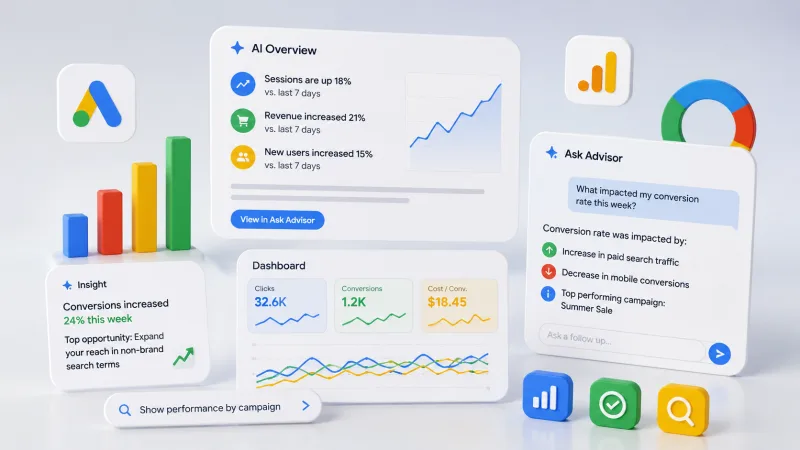
Google is adding automated dashboards and conversational reporting to Google Ads and Analytics. For performance teams working with daily spend decisions, this matters: the faster you spot an anomaly or a conversion drop, the less budget bleeds into ineffective traffic.
The core idea is simple. Google is shortening the path from question to insight. Previously, a media buyer had to open several reports, configure filters, compare periods, and then explain the result to a client or team lead. Now part of that routine can be delegated to the system.
What the new AI capabilities deliver in practice
Automated dashboards highlight signals that matter: CTR drops in a specific ad group, rising CPA by device or geo, conversion decline after a creative swap, or traffic spikes without proportional lead growth. For arbitrage, this is especially useful. When you push traffic to an iGaming or fintech offer, you need to know where the funnel breaks: clicks happen, registrations happen, deposits do not. An automated dashboard catches that gap faster.
Conversational reporting works like an AI assistant. Instead of building a complex query manually, you ask in plain language: 'Why did ROAS drop last week?' or 'Which campaigns gave the best CPA on Android?' For digital teams, this removes dependency on the one person who 'knows how to pull data'. It speeds up the media buyer, account manager, and analyst at once.
Why this matters for performance and affiliate
In affiliate marketing, reaction speed almost always affects ROI. If you work with paid traffic, every extra hour without understanding the cause of a drop can cost budget. AI agents in Ads and Analytics are useful not as a trend, but as a tool for cutting time-to-insight.
They help find bottlenecks in the funnel faster. If you have traffic from multiple sources, AI reports show what declined: clicks, registrations, confirmations, first deposits, or repeat deposits. For iGaming offers, this is critical. Identical CTR does not mean identical value.
They make it easier to compare creatives and audiences. When you run dozens of combinations, manual analysis turns into chaos. A conversational interface lets you ask: 'Which combination gave the best EPC for female 25–34 in LatAm?' or 'Which ads had the best CR on mobile?'
They simplify explaining results to business stakeholders. Not every client or manager wants to look at twenty tables. An automated dashboard can become the layer of truth showing what matters: spend, revenue, conversions, ROAS, and daily segment dynamics. This is especially useful in agency models where transparency counts.
They reduce manual work on routine. AI does not replace a performance specialist, but it removes part of the mechanical work. Instead of assembling the same thing every day, you can focus on hypotheses: change the creative, test a new geo, rebuild campaign structure, check the landing page.
What can go wrong
Any automation in analytics works until you start trusting it blindly. An AI agent is an accelerator, not a source of absolute truth.
If data is poorly tagged, the system may draw a formally logical but incorrect conclusion. For example, it might see traffic growth and call it success, even though FTD or LTV dropped.
In advertising, it is easy to confuse symptom and cause. A conversion drop may stem not only from the creative, but from the landing page, tracking, load speed, auction changes, or traffic quality. AI helps you notice the signal, but a specialist still has to verify the cause.
If GA4, Ads, and internal CRM events do not align in logic, any automatic report will be built on a flawed base. For affiliate teams, this is especially painful: when postback, UTM, and cabinet events live separately, analytics turns into an argument over numbers.
Sometimes a well-designed dashboard creates an illusion of control. But if you lack a unified attribution scheme, proper segmentation, and stable evaluation windows, the numbers may look convincing and mean little.
How to prepare your data for AI analytics
For automatic reports to actually help, you need to clean up your base. Otherwise AI will just accelerate chaos.
Unify campaign and ad group names. If you have 'geo_za_android_fb_v1' in one place and 'ZA-Android-FB-01' in another, the system will struggle to assemble logic.
Define a single set of KPI. For some teams it is CPA and CR, for others ROAS, LTV, payout, FTD rate. The key is that everyone works with the same terminology.
Check the Ads → Analytics → CRM link. AI does not compensate for leaky tracking. Events must match by time, source, and conversion type.
Separate reporting levels. One dashboard for operational control, another for strategic decisions. Do not mix daily bid monitoring with quarterly economic evaluation.
Compile a list of typical questions. This speeds up work with conversational reporting. For example: 'which campaigns dropped in ROI over three days', 'where did CPA rise', 'which geo gives the best revenue per user'.
How to use AI reports in daily work
AI agents deliver the most value where there is discipline in decision-making. If the team works chaotically, no assistant will save you. But if you have a regular process, the effect will be tangible.
A morning scenario for a buyer or analyst: open the automated dashboard and check deviations over the last 24 hours. See where CTR, CPC, CPA, and CR changed. Ask the system which segments showed the largest deviation from normal. Cross-check the answer with raw data and events on the CRM or tracker side. Make a decision: pause, reallocate budget, swap creative, change targeting.
This saves time not only in media buying. For SEO teams and content projects, similar logic works: you see faster which pages or clusters declined, where traffic changed, which sources contribute most to conversion.
In iGaming, analytics is almost always multilayered. The same source may deliver good CTR and poor deposit, or vice versa. AI reports are useful in breakdowns: by geo, by device, by operators and landing pages, by time of day, by creatives and formats, by funnel stages — click, registration, FTD, repeat. If the system can answer such questions quickly, the team understands faster where to scale a combination and where to cut budget.
What this means for the market
The appearance of AI agents in Ads and Analytics is part of a broader trend: ad platforms are becoming not just a place to buy traffic, but a full operational environment for decision-making. First bids and audiences were automated, now the analytics layer is being automated.
For the market, this means several things. Analytics will become more accessible to smaller teams. Decision speed will increase. Requirements for data quality and tracking will become stricter. The value of a specialist will shift from 'assemble a report' to 'interpret correctly and act'.
This is where teams that can build a transparent system gain an advantage. If you have order in events, campaigns, and KPI, an AI assistant becomes a strong accelerator. If there is no order, it will just show faster how neglected everything is.
Conclusion
Automated dashboards and conversational reporting in Google Ads and Analytics are not a replacement for an analyst, but a tool for faster and more accurate work with data. For performance marketing, affiliate, and iGaming, this is especially useful: here the cost of error is higher and the window for reaction is shorter.
The winners will not be those who turn on AI features first, but those who prepare data structure, KPI, and decision-making process in advance. Then artificial intelligence will stop being just an interface and start actually saving money, time, and team nerves.


