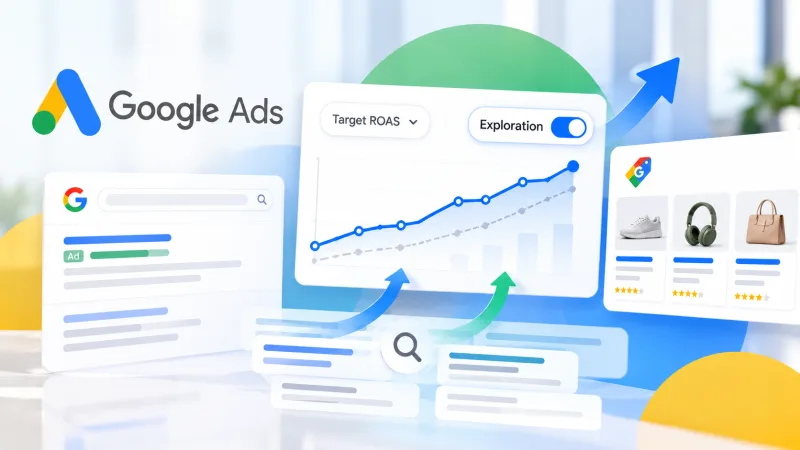
Google Ads has extended Smart Bidding Exploration to Performance Max and Shopping campaigns. The mechanic previously ran in Search; the same logic now reaches the campaign types where most of the budget sits with automation. For buyers running traffic to CPA offers through PMax, that is a direct change to the rules.
What Exploration does
The algorithm is allowed to move away from historical conversions. Rather than bidding only for audiences that have already proved their value, it tests new segments. Google's own line is that the expansion opens more conversion opportunities. The campaign stops feeding on its own history.
For an affiliate that cuts both ways. Fresh conversion paths matter once the old audiences burn out. But exploration means experiments, and part of the budget can go to less predictable places. Not a reason to switch it off. A reason to watch the numbers.
Why PMax and Shopping
Performance Max and Shopping already leave targeting largely to the system, which decides who sees what. Exploration gives it more room to look for conversions outside the record. Campaigns built on a narrow set of audiences and firm bids may start behaving differently, and not always as expected.
What to check in the account: conversion goals, so the system optimises for the action you want rather than a cheap click; conversion values, split where possible, so exploration moves toward the more valuable actions; daily spend, since a sharp jump is the first sign the system has gone into research; and audience signals in PMax, which exploration may pass over if it finds another route to a conversion.
For iGaming and affiliate work predictability is the point. More freedom to experiment means revshare and ROI can swing harder. Testing new set-ups more often is the practical response, for instance one campaign on exploration logic and one on a more conservative approach, so the results can be compared without noise. Where several geos or offers share an account, exploration may shift impressions toward the one the algorithm rates higher. Splitting the structure makes that shift easy to see.
There is no single answer on timing. A stable account with conversions set up and budget headroom gets a chance at new growth points. A fresh account or a tight CPA ceiling is better off building history first. Either way, the feature should not run unattended.


