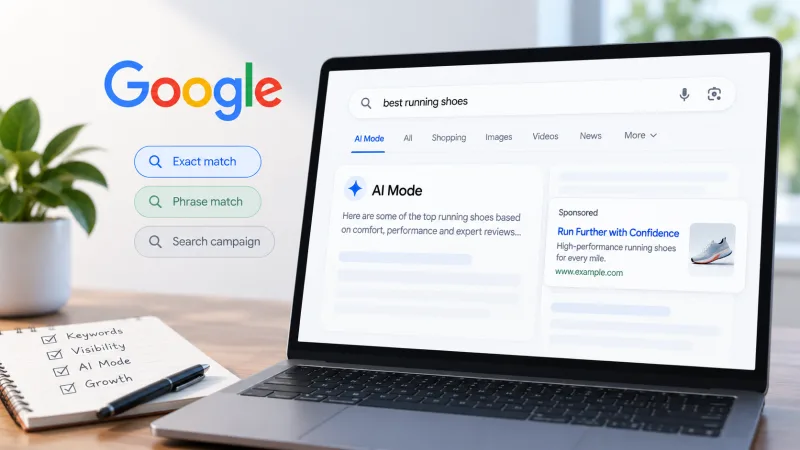
Google has started testing Search ads in AI Mode for queries with clear, direct intent. The test includes exact match and phrase match campaigns. For advertisers, this signals that AI-powered search is gradually converging with traditional paid search, though query control remains paramount.
For affiliate teams, iGaming buyers and performance marketers, this is not a call to rewrite every campaign. But it is time to tidy up keyword semantics, group structure and landing page logic. If the format moves beyond testing, the first winners will be those whose Search campaigns are built cleanly, without junk phrases and vague offers.
What Google is testing
The test is straightforward: Google is checking how traditional Search campaigns perform inside AI Mode. Not all match types are included — only exact match and phrase match. Ads appear when the user shows clear, direct intent.
This is an important detail. AI Mode is often associated with long conversational queries, follow-ups and exploratory behaviour. But Google is looking at a different scenario: the user already knows what they want and phrases the query specifically. In that moment, search advertising is closer to the familiar model, where the bid depends on intent, ad relevance and the landing page.
Exact match and phrase match make sense here. These match types give the advertiser more control over which formulations trigger the ad. For an AI interface this is especially sensitive, because the user may receive not a list of links but an answer in a different form. The tighter the match between query, ad and offer, the lower the risk of an irrelevant click.
Why direct intent became the focus of the test
Paid search has historically been strong where intent is expressed explicitly. The user is searching for a brand, product, promo code, bonus, registration, comparison or specific service. In such situations, advertising can land at the moment of decision.
AI Mode changes the interface, but it does not cancel intent. If someone enters a direct query, the ad system can still treat it as commercial. Google is testing this segment because it is closer to the familiar economics of Search: the advertiser pays for a click, the user sees a relevant offer, the system evaluates the quality of the interaction.
For arbitrage this is especially visible in verticals where queries often carry readiness to act. iGaming, finance, software, nutra, subscriptions, dating — everywhere there are phrases where the user is already close to conversion. But in AI Mode such a query may be rephrased, expanded or embedded in a dialogue. So the advertiser needs to understand which formulations actually lead to conversion, and which only inflate spend.
What this means for Search campaign structure
Google's test reinforces an old point: chaotic keyword semantics handle any change in search poorly. If a campaign relies on overly general queries, AI Mode may add even more uncertainty. If the structure is built around clear intents, adaptation will be smoother.
The practical approach:
- Separate brand, competitor and product queries.
- Do not mix informational and transactional phrases in one group.
- For exact match, keep formulations with proven conversion.
- For phrase match, use clusters where word order and context matter.
- Keep negative keywords current, especially for free, review and educational queries.
If the account has not had search terms cleaned in a while, start there. AI Mode is being tested on direct intent, which means the quality of that intent must be visible. A query with high CTR may not deliver leads. A query with lower volume may bring better ROI. In Search this is routine work, but now it becomes more important.
How to rebuild keyword semantics for AI Mode
There is no need to guess how exactly Google will develop the test. Better to prepare what is already under the advertiser's control.
Start with a search terms export. Select queries where intent is clear without additional explanation. For example, the user is searching for a specific action, product type, bonus or registration. Such phrases suit exact match if they already have conversions or quality micro-conversions.
Next, check phrase match. There, queries where meaning is preserved with small additions are useful. But phrase match can pull in adjacent intents, so negative keywords are needed immediately, not after budget has been burned.
Separately, look at the query-ad-landing page connection. In AI Mode the user may expect a more direct answer. If the ad promises a bonus but the landing page hides the conditions, conversion will drop. If the query is about registration but the landing leads to a general section, part of the traffic will leave without action.
For an affiliate marketer this is not just a CTR question. High CTR with weak post-click behaviour worsens the economics of buying traffic. Especially on CPA, where the advertiser pays upfront and quality confirmation comes later.
What affiliate teams and iGaming buyers should watch
In iGaming and related verticals, Search is often used for hot demand. The user is searching for a bonus, promo code, official site, reviews or a brand alternative. AI Mode may become another point of contact with such demand if the test moves beyond a limited circle.
Teams should prepare several things in advance.
First — an intent map. Not all queries with commercial words deliver the same conversion. Divide phrases by stage: interest, comparison, choice, action. For exact match, keep the bottom of the funnel.
Second — clean offers. If the ad leads to revshare or a CPA offer, the wording must match what the user will see on the page. Promises in the creative and conditions on the landing should not contradict each other.
Third — control of brands and compliance. In competitor queries and iGaming advertising the price of error is higher. Phrase match without negative keywords can lead to impressions on unwanted combinations. This hits the budget and creates unnecessary account risks.
Fourth — separate analytics. If Google starts to deliver more signals on AI Mode, compare that traffic separately from regular Search. Merging everything in one report is convenient, but it is easy to miss a drop in ROAS or a rise in empty clicks.
Risks for advertisers
The main risk is losing the sense of control. Search advertising has long been built around a clear chain: query, ad, click, landing. AI Mode adds a new interface layer. Even if the impression is served on exact or phrase match, the user journey may differ from the classic search results page.
The second risk is connected to overestimating the test. The fact of testing does not mean mass rollout for all accounts and GEOs. There is no reason to break working campaigns for a format that is still being checked. It is more sensible to strengthen basic things: keyword semantics, negative keywords, offer-landing match, conversion tracking.
The third risk is phrase match that is too broad. It may look safer than broad match, but it still requires control. In themes with expensive clicks, even a small shift in intent quickly eats margin.
How to act now
A plan with no sharp moves:
- Audit exact and phrase match in Search campaigns.
- Find queries with direct intent and stable conversion.
- Separate groups by funnel stage.
- Update negative keywords from search terms data.
- Check whether the promise in the ad matches the landing page content.
- Set up reports to quickly spot changes in CTR, CPA, ROI and ROAS.
If AI Mode becomes a significant source of paid traffic, the winners will not be those who increase budget first. Accounts will perform better where every query is tied to a clear intent, the ad does not mislead, and the landing meets user expectation.
Google is testing a cautious scenario: traditional Search ads inside AI Mode, but only when user intent is clear. For the market this is a signal toward discipline in paid search. Less junk semantics, more attention to query meaning and the quality of the chain to conversion.


