ux — Claude Code plugin: what it does, how to install
ux gives Claude Code a deterministic design engine for UI work, with brand-aware synthesis, UX checks, accessibility commands, and anti-slop linting.
MIT ★ 110 updated 2026-10-25
/plugin marketplace add Laith0003/ux-skill
/plugin install ux@ux-skillWhat ux does
ux adds 25 slash commands, 5 sub-agents, and 18 MCP tools to Claude Code. Its Python core turns a brief into a design language across seven axes: warmth, contrast, density, geometry, formality, motion, and type personality. Dispatch selects a strict brand mode, a brand blend, or synthesis without a named brand.
The plugin ships with JSON manifests covering styles, palettes, type pairings, components, industries, motion presets, UX laws, and anti-patterns. A 152-rule linter scores interface output, while /ux-evolve runs a lint, polish, and re-check cycle. The local .ux/decisions.jsonl ledger feeds accepted decisions back into recommendations. It runs offline and makes no LLM calls. The Python core requires Python 3.9+.
What it helps with
- generate a design language from a brief
- audit an interface for UX and accessibility issues
- spot AI-slop patterns in UI code
- derive brand tokens and reusable components
Example prompts for the agent
- Use
/ux:recommendto choose a visual direction for this interface brief. - Run
/ux:auditon the current page and list its UX and accessibility issues. - Use
/ux:evolveto lint the project, apply improvements, and score it again.
How to install ux
Plugin marketplace
/plugin marketplace add Laith0003/ux-skill/plugin install ux@ux-skillStep by step, with commands for each platform: Claude Code plugins: marketplaces, installing, and building your own
Questions about ux
How do I install ux in Claude Code?
Add the marketplace with /plugin marketplace add Laith0003/ux-skill, then install the plugin with /plugin install ux@ux-skill.
What does the ux plugin do?
It gives Claude Code commands and tools for interface design, UX review, accessibility checks, brand-aware synthesis, and anti-slop linting.
Does ux need an internet connection or an LLM?
The plugin runs offline and does not call an LLM. Its Python core requires Python 3.9+.
Source text
SKILL.md · MIT
**English** · [العربية](README.ar.md) · [简体中文](README.zh.md) · [繁體中文](README.zh-TW.md) · [日本語](README.ja.md) · [한국어](README.ko.md) · [हिन्दी](README.hi.md) · [Bahasa Indonesia](README.id.md) · [Tiếng Việt](README.vi.md) · [ไทย](README.th.md) · [Français](README.fr.md) · [Deutsch](README.de.md) · [Español](README.es.md) · [Português](README.pt-BR.md) · [Italiano](README.it.md) · [Русский](README.ru.md) · [Türkçe](README.tr.md)
# ux-skill: the design intelligence engine for Claude Code, Cursor, and every other AI coding tool
**A design-intelligence engine that makes AI-generated UI distinctive instead of generic.** Drop it into any of 17 AI coding tools and your output stops reading as AI-built. Free, MIT, offline, no LLM.
```bash
pip install uxskill
```
**[Star ux-skill on GitHub](https://github.com/Laith0003/ux-skill)** if this is useful, it is the single cheapest way to help the project. New here? Start with the [60-second tour](#quick-install) or see it live at [uxskill.laithjunaidy.com](https://uxskill.laithjunaidy.com).
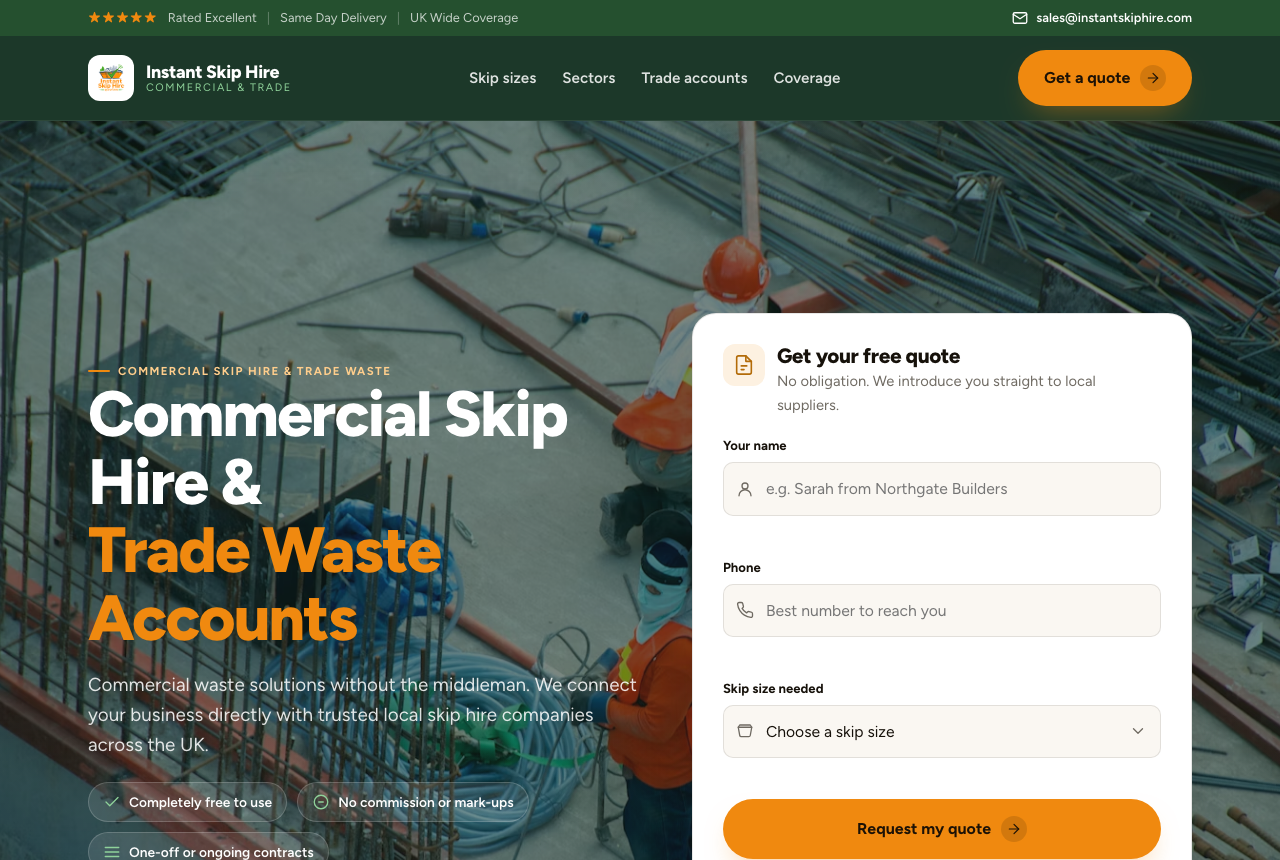
*Before: generic stock-photo SEO slop. After: real construction-photo hero under a dark scrim, editorial headline with an amber accent, quote form in the hero. Same AI coding tool, same prompt, different result when ux-skill supplies the constraints.*
> **v3.1.0, THE BRAIN, now brand-true + responsive.** The strongest UX plugin for AI coding. A Python reasoning core with a deterministic 7-axis synthesizer, 12 queryable JSON manifests (84 styles, 176 palettes, 70 type pairings, 148 components, 184 industries, 35 chart types, 57 motion presets, 112 UX laws, 152 anti-pattern rules, 25 tech stacks, 160 brand specs), 25 slash commands, 5 sub-agents, 18 MCP tools, and a deterministic anti-AI-slop linter. Cross-IDE: ships into Claude Code, Cursor, Windsurf, GitHub Copilot, Gemini CLI, Codex, Kiro, Cline, Continue, Aider, Zed, JetBrains AI, Pieces, Tabby, Tabnine, CodeWhisperer, and Roo Cline.
> **The brand name is `ux-skill`.** The PyPI / npm package name stays `uxskill`. The GitHub repo lives at [`Laith0003/ux-skill`](https://github.com/Laith0003/ux-skill).
**Author:** [Laith Aljunaidy](https://laithjunaidy.com), designer and CTO in Amman · **Site:** [uxskill.laithjunaidy.com](https://uxskill.laithjunaidy.com) · **Compare vs every Claude UX plugin:** [compare.html](https://uxskill.laithjunaidy.com/compare.html) · **GitHub:** [Laith0003/ux-skill](https://github.com/Laith0003/ux-skill) · **PyPI:** [uxskill](https://pypi.org/project/uxskill/) · **npm:** [uxskill](https://www.npmjs.com/package/uxskill)
[](https://github.com/Laith0003/ux-skill/releases)
[](https://www.python.org/downloads/)
[](LICENSE)
[](#the-17-ide-installer)
[](#)
[](data/brands/_index.json)
[](data/components.json)
[](data/anti-patterns.json)
[](https://github.com/Laith0003/ux-skill/actions)
[](data/motion-presets.json)
[](https://github.com/Laith0003/ux-skill/stargazers)
[](https://pypi.org/project/uxskill/)
[](https://discord.gg/uxskill)
### New in v3.1: brand-true, responsive, alive
- **Brand fidelity is enforced, not hoped.** The primary color is read from the LOGO's pixels (not the most-painted CSS); default fonts are rejected for the logo's letterform style. The extracted brand travels `recommend` -> `synthesize`, and a **hard floor** in `evaluate` FAILS any output that drops the brand color/logo or ships no real imagery. Two-way interop with the open `brand.md` convention (render + ingest).
- **Mobile-first, gated.** New craft foundations (`responsive.md`, `component-behaviors.md`) plus a wrap-aware gate that fails on horizontal scroll, a wrapping nav/wordmark/button label, or an over-tall sticky header.
- **The wow layer.** The engine derives 2-3 coordinated signature moments per page, the "wow can only come from the user" doctrine is overturned.
- **Sharper linter** (152 rules): imagery-mandatory + icon-only detection, placeholder-token and `100vw` rules; seeded picsum kept, random stripped.
Tests **310 passing**. Offline. Deterministic. No LLM ever called. Full notes in [CHANGELOG.md](CHANGELOG.md).
### What's new in v3
- **Brand specs become training data, not templates.** The 160 brand specs are no longer a catalogue the recommender picks from, they're vocabulary the synthesizer distills from. Output is novel every call.
- **7-axis synthesizer** (warmth, contrast, density, geometry, formality, motion, type_personality). Briefs map deterministically to axis values; axis values compile to fresh palette + type + spacing + radius + motion tokens.
- **Three auto-dispatched modes**: `strict_brand` (100% of one brand), `brand_anchor` (70% one brand + 30% axis-adapted siblings), `pure_synthesis` (no brand named, distill from 8 axis-matching exemplars).
- **Decisions ledger drives the recommender.** `.ux/decisions.jsonl` re-ranks candidates by past wins in the same `(industry, ui_type)` bucket. Cold-start safe. Counts only `lint_score >= 80` + `user_accepted = true` decisions.
- **Axis interaction matrix**: explicit conflict resolution between competing axes (dense + corporate → 4px, airy + corporate → 12px, soft + playful → 18px radius). No more silent ad-hoc rules.
- **`/ux-evolve` auto-loop**: lint → polish → re-lint until score ≥ 90 or plateau or 5 rounds. Quality gate at 65.
- **3 new MCP tools** (15 → 18): `ux_synthesize`, `ux_decisions_query`, `ux_decisions_stats`.
- **Local stats dashboard**: `uxskill stats --html` writes `.ux/stats.html` showing what YOUR install has learned. No telemetry, no global aggregate.
- **223 tests pass.** Offline. Deterministic. No LLM ever called.
Full details in [CHANGELOG.md](CHANGELOG.md#300--2026-05-28--the-brain).
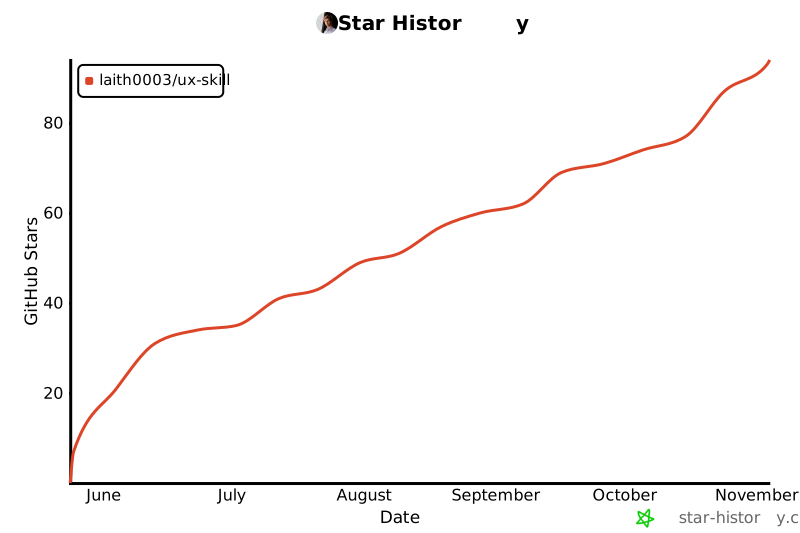
### Star history
[](https://star-history.com/#Laith0003/ux-skill&Date)
---
## What is ux-skill
ux-skill is a **design intelligence engine** for AI coding tools. It runs as a Python package (`pip install uxskill`), as a Claude Code plugin, and as a 17-IDE multi-installer. The engine ingests a project brief (industry, audience, tone, must-haves, forbidden moves, stack, region) and returns a complete recommended design system: style, palette, type pair, motion presets, components, brand exemplars to study, and the anti-pattern guardrails that must hold. The recommendation is deterministic, same input always produces the same output.
The plugin sits between you and the AI coding tool. When you ask Claude Code, Cursor, or any other AI assistant to "build a fintech landing page," the assistant typically improvises, and the result reads as AI-generated within five seconds (purple-to-blue gradients, three equal cards, Inter at display size, "John Doe" in testimonials, 300ms default transitions, centered hero, bouncing arrow CTAs). ux-skill replaces improvisation with **structured constraints**: you run `/ux-discover` to capture the brief, `/ux-recommend` to pick the system, `/ux-design` to generate the code, and `/ux-lint` to verify it passes the 152 deterministic anti-AI-slop rules before commit.
This README is the canonical reference. Every command, every sub-agent, every data manifest, every install path, every brand spec, every anti-pattern category, it's all documented here. If you're shopping for a Claude Code design plugin or comparing AI design tools for Cursor, Windsurf, or Codex, read this top to bottom and the [compare.html](https://uxskill.laithjunaidy.com/compare.html) side by side.
---
## Table of contents
1. [The Brain, what v3.0 is](#the-brain-what-v30-is)
2. [Quick install](#quick-install)
3. [The numbers, live comparison vs the top 8 Claude UX skills](#the-numbers-live-comparison-vs-the-top-8-claude-ux-skills)
4. [Architecture, how the pieces fit](#architecture-how-the-pieces-fit)
5. [The 25 slash commands, detailed reference](#the-25-slash-commands-detailed-reference)
6. [The 5 sub-agents](#the-5-sub-agents)
7. [The 11 data manifests](#the-11-data-manifests)
8. [The 152 anti-AI-slop rules, the linter](#the-152-anti-ai-slop-rules-the-linter)
9. [The 160 brand DESIGN.md specs, by category](#the-160-brand-designmd-specs-by-category)
10. [MCP server, the asymmetric move](#mcp-server-the-asymmetric-move)
11. [The 17-IDE installer](#the-17-ide-installer)
12. [Use cases, concrete scenarios](#use-cases-concrete-scenarios)
13. [Compared to alternatives](#compared-to-alternatives)
14. [Roadmap](#roadmap)
15. [Contributing](#contributing)
16. [License, author, acknowledgments](#license-author-acknowledgments)
---
## The Brain: what v3.0 is
v3.0.0 is the biggest architectural shift in ux-skill's history. The recommender no longer picks templates from a catalogue, the engine **synthesizes** a fresh design language per brief. Same brief always yields the same output (fully deterministic), but every distinct brief gets its own novel system. Brand specs aren't templates anymore; they're training data the engine learns the vocabulary from. The system has eyes on its own history, closes the feedback loop locally, and never calls an LLM.
The compiler is a **deterministic 7-axis synthesizer**, warmth, contrast, density, geometry, formality, motion, type_personality. Every brief maps to axis values; axis values compile to fresh palette + type + spacing + radius + motion tokens. Modular type scales pick their ratio from contrast (1.200 quiet / 1.250 balanced / 1.333 loud). Layout primitives are responsive by construction (`auto-fit minmax(min(N, 100%), 1fr)` + container queries). Broken layouts can't be emitted because they aren't representable.
There are three auto-dispatched modes: `strict_brand` (`reference_brands=[stripe] strict=True` → 100% Stripe tokens, fastest path); `brand_anchor` (`reference_brands=[stripe]` → 70% Stripe + 30% axis-adapted from 4 sibling brands); and `pure_synthesis` (no brand named → infinity space, 8 axis-matching exemplars distilled into a novel design language). Conflicting axes are resolved by a documented **axis interaction matrix**, dense + corporate compiles to 4px (density wins, Bloomberg-school), airy + corporate to 12px (formality wins, luxury), soft + playful to 18px radius, sharp + corporate to 2px. No silent ad-hoc rules in the implementation.
The **decisions ledger** (`.ux/decisions.jsonl`, schema `_v: 1` locked) closes the feedback loop. The recommender now re-ranks candidates by past wins in the same `(industry, ui_type)` bucket. Cold-start safe, it skips below 3 priors. It only counts decisions with `lint_score >= 80` AND `user_accepted = true`. Plus `/ux-evolve` runs lint → polish → re-lint until score ≥ 90 or plateau or 5 rounds, with a 65-score quality gate below which output is refused unless `--force`. The result: every install gets smarter on its own corpus, every run is reproducible across machines, and the engine stays fully offline.
---
## Quick install
Three install paths. Pick the one that matches your environment.
### Path 1: Claude Code marketplace (canonical)
If you live in Claude Code, install via the plugin marketplace:
```bash
/plugin marketplace add Laith0003/ux-skill
/plugin install ux@ux-skill
```
That wires all 25 slash commands and 5 sub-agents into your Claude Code session. After install, run `/ux-init` to set up the per-project `.ux/` state directory and verify the Python engine is reachable.
### Path 2: pip (universal)
If you live outside Claude Code (Cursor, Windsurf, CLI, CI), install the Python package:
```bash
pip install uxskill
uxskill init # auto-detects your IDE, installs the right artifact
uxskill stats # print manifest counts to verify install
uxskill lint . # run the linter against the current directory
```
The package exposes both `ux` and `uxskill` as CLI entry points, they're the same binary.
### Path 3: npx (no Python required)
If you don't want to manage Python directly, the npx wrapper bootstraps everything via `pipx`:
```bash
npx uxskill init # downloads pipx + uxskill on first run
npx uxskill recommend --industry=fintech-neobank --tone=warm --stack=nextjs-15-app-router
```
### Verify install
```bash
ux stats
# {
# "version": "3.0.0-stable",
# "counts": {
# "styles": 84,
# "palettes": 176,
# "type-pairs": 70,
# "components": 148,
# "industries": 184,
# "chart-types": 35,
# "tech-stacks": 25,
# "ux-guidelines": 112,
# "motion-presets": 57,
# "anti-patterns": 145,
# "brands": 160
# }
# }
```
If any count returns 0, the JSON file is missing, open an issue at [github.com/Laith0003/ux-skill/issues](https://github.com/Laith0003/ux-skill/issues).
---
## The numbers: live comparison vs the top 8 Claude UX skills
Star counts last verified via `gh api` on **2026-05-28**. ux-skill (Laith0003/ux-skill) is the newest entrant, we're tiny on awareness, deep on architecture. The comparison below is honest: where we lose, where we win.
| Plugin | Stars | Architecture | Slash commands | Linter (CI-safe) | Brand specs | Components | Motion presets | IDEs supported |
|---|---:|---|---:|---|---:|---:|---:|---:|
| nextlevelbuilder/ui-ux-pro-max-skill | **83,958** | Python BM25 + CSV, single skill | 1 | - |, | 0 | 0 | 18 |
| nexu-io/open-design | **54,406** | Node.js + 19 skills + preview | 19 | - |, | 0 | 0 | 1 |
| Leonxlnx/taste-skill | **25,202** | Bash + research-backed taste | 1 | - |, | 0 | 0 | 1 |
| alchaincyf/huashu-design | **15,455** | Single 62 KB SKILL.md + scripts | 1 | - |, | 0 | 0 | 1 |
| google-labs-code/stitch-skills | **5,762** | MCP-wired skill library | multi | - |, | 0 | 0 | 1 |
| dominikmartn/nothing-design-skill | **2,391** | Single-aesthetic skill | 1 | - |, | 0 | 0 | 1 |
| Nutlope/hallmark | **2,164** | Anti-slop design skill | 1 | - |, | 0 | 0 | 1 |
| hamen/material-3-skill | **955** | MD3 components + audit | 1 | - | (MD3 only) | 0 | 0 | 1 |
| **Laith0003/ux-skill (ux-skill)** | **14** | **Python engine + 12 manifests + 25 commands + 5 sub-agents + CI linter** | **22** | **152 regex rules** | **160** | **148** | **57** | **17** |
### Where we lose
- **Awareness.** They have hundreds of thousands of stars. We have 14. Star us, it's the cheapest way to help.
- **Brand recognition.** ui-ux-pro-max and open-design have a head start measured in months, not days.
- **Marketing polish.** They have screenshots, demo videos, and a discoverable landing page. We have a thorough README and a thin landing.
### Where we win
- **Component library:** 148 documented components with anatomy, states, tokens used, and motion specs. None of the other 8 ship a component manifest.
- **Motion presets:** 57 stack-ready entries (Framer Motion, GSAP, CSS) with reduced-motion fallbacks. None of the others ship a motion manifest.
- **Anti-pattern linter:** 152 deterministic regex rules, runs in CI, exits non-zero on Critical/High. None of the others ship a deterministic linter.
- **Brand specs:** 160 real DESIGN.md specs (Apple, Stripe, Linear, Figma, Tesla, BMW, Notion, Spotify, Airbnb, Vercel, Supabase, Cursor, Raycast, Claude, and 96 more). None of the others ship a brand library.
- **17 IDEs supported:** same engine, different glue per IDE.
- **25 slash commands:** discovery, generation, audit, lint, polish, fix loop, case-study, workshop, copy, motion, a11y, dashboard, conductor, fully integrated.
Full table-by-table side-by-side at [uxskill.laithjunaidy.com/compare.html](https://uxskill.laithjunaidy.com/compare.html).
---
## Architecture: how the pieces fit
```
ux-skill (package name: uxskill)
│
├── data/ The brain, queryable JSON manifests
│ ├── styles.json 84 design styles + when/skip + tokens
│ ├── palettes.json 176 palettes (light/dark, contrast verified)
│ ├── type-pairs.json 70 display × body × mono triplets
│ ├── components.json 148 components (anatomy, states, motion)
│ ├── industries.json 184 industry rules + audience signals
│ ├── chart-types.json 35 chart types (when/skip, encoding)
│ ├── tech-stacks.json 25 stacks (Next, Astro, SvelteKit, Blade...)
│ ├── ux-guidelines.json 112 named UX laws (Hick, Fitts, Miller...)
│ ├── motion-presets.json 57 motion presets (entry, exit, hover...)
│ ├── anti-patterns.json 152 regex rules (CI-safe linter source)
│ └── brands/*.json 160 brand DESIGN specs + _index.json
│
├── engine/ Python, the reasoning
│ ├── synthesizer/ v3-7-axis deterministic compiler
│ ├── decisions/ v3, .ux/decisions.jsonl ledger + recommender re-rank
│ ├── recommender/ 5-parallel-search merge engine (re-ranked by decisions)
│ ├── linter/ Deterministic anti-slop scanner
│ ├── discovery/ 10-field forcing protocol
│ ├── generator/ Token + manifest emitter
│ ├── installer/ 17-IDE multi-installer
│ └── cli/ `ux` / `uxskill` entry point
│
├── commands/ 22 Claude Code slash commands (.md)
│ ├── ux-init.md bootstrap
│ ├── ux-stats.md inventory snapshot
│ ├── ux-discover.md 10-field intake (gate)
│ ├── ux-recommend.md FLAGSHIP, 5-parallel search
│ ├── ux-lint.md deterministic linter
│ ├── ux-design.md generate frontend code
│ ├── ux-component.md generate one component
│ ├── ux-system.md generate full design system
│ ├── ux-dashboard.md generate dashboard surface
│ ├── ux-motion.md motion treatment + audit
│ ├── ux-audit.md 6-lens design audit
│ ├── ux-a11y.md WCAG 2.1 AA audit
│ ├── ux-critique.md taste critique (3 wins, 3 misses, 1 move)
│ ├── ux-copy.md microcopy review + rewrite
│ ├── ux-fix.md apply findings as atomic commits
│ ├── ux-polish.md cosmetic pass + AI-slop kill
│ ├── ux-frame.md 4-field framing block
│ ├── ux-research.md research planning + synthesis
│ ├── ux-workshop.md 5-phase design thinking workshop
│ ├── ux-case-study.md publishable monochrome editorial case study
│ ├── ux-next.md workflow conductor (read-only)
│ └── ux-expert.md consulting hook
│
├── agents/ 5 sub-agents (.md)
│ ├── frontend-engineer.md React/Next/Vue/Blade/Astro
│ ├── motion-engineer.md Framer Motion / GSAP / CSS
│ ├── copy-writer.md microcopy in brand voice
│ ├── research-synthesizer.md interviews + analytics + competitors
│ └── design-system-architect.md tokens / components / foundations
│
├── references/ Prose source for the data + demo pages
│ ├── foundations/ anti-patterns.md, principles, taste
│ ├── laws/ UX laws long-form
│ ├── process/ discovery-protocol.md (load-bearing)
│ ├── styles/ per-style prose (anti-slop.md, etc.)
│ ├── components/ component long-form
│ ├── output/ output rubrics
│ └── conditional/ stack-specific guidance
│
├── bin/
│ ├── uxskill.mjs npx wrapper -> Python engine
│ ├── ux-lint.py v2 linter (preferred)
│ └── ux-lint.sh v1 fallback (bash + perl-PCRE)
│
└── .ux/ (created per project)
├── last-discovery.json brief snapshot
├── last-recommendation.json picked system
├── last-frame.json framing block
├── last-audit.json / last-a11y.json / last-copy.json / last-motion.json
├── last-design.json / last-component.json / last-dashboard.json
└── last-critique.json / last-polish.json / last-research.json / last-workshop.json / last-case-study.json
```
### How the engine actually works
1. **Input.** You provide a brief, either interactively via `/ux-discover` (10 fields) or non-interactively via flags to `ux recommend`.
2. **5 parallel searches.** The engine runs five lookups concurrently across the manifests:
- **Industry → recommended_styles** (industries.json)
- **Style → palette + type + motion compatibility** (styles.json)
- **Tone × must-have → palette filter** (palettes.json)
- **Stack → component compatibility + motion presets** (tech-stacks.json, motion-presets.json)
- **Forbidden + region → guardrails + brand exemplar shortlist** (anti-patterns.json, brands/)
3. **Merge.** A deterministic merger ranks candidates, resolves conflicts (e.g., must-have dark-mode forces palette mode), and emits a single recommended system.
4. **Output.** A JSON document with the picked style, palette, type pair, top 5 motion presets, top 12 components, top 5 brand exemplars, and all 152 anti-pattern guardrails active. Plus a rationale block explaining each pick.
5. **Generation.** Downstream commands (`/ux-design`, `/ux-component`, `/ux-system`, `/ux-dashboard`) consume the recommendation to generate actual code via the sub-agents.
6. **Verification.** `/ux-lint` re-scans the generated code against the 152 regex rules. Exits non-zero on Critical/High in CI.
**v3 additions.** The recommender now re-ranks candidates from `engine/decisions/` using `.ux/decisions.jsonl` (only counts decisions with `lint_score >= 80` AND `user_accepted = true`; cold-start safe below 3 priors). The generator path can dispatch into `engine/synthesizer/`, a deterministic 7-axis compiler that produces fresh palette + type + spacing + radius + motion tokens per brief instead of picking templates from a catalogue. See [The Brain, what v3.0 is](#the-brain-what-v30-is) for details.
**Python thinks. HTML shows. Markdown chains.**
---
## The 25 slash commands: detailed reference
Every command is shipped as a `.md` file under `commands/` with `description`, `allowed-tools`, `triggers`, `when to use`, `when to skip`, `input`, `process`, and `output state file`. The descriptions below are condensed; the full source is the canonical spec.
Commands are grouped into five buckets: **bootstrap & inventory**, **discovery & recommendation**, **generation**, **audit & verify**, **fix & polish**, and **conductor**.
### Bootstrap & inventory
#### `/ux-init`: bootstrap the project
- **What:** Detects which IDE you're using (`.claude/`, `.cursor/`, `.windsurf/`, etc.), installs the right artifact, verifies the Python engine is reachable, prints a stats snapshot.
- **When to use:** First time installing in a new project. After cloning a project that uses ux-skill. After `pip install --upgrade uxskill`.
- **When to skip:** You already ran it in this project and nothing changed.
- **Invocation:** `/ux-init` (no args) or `uxskill init` from the CLI.
- **Output:** Per-IDE artifact (see [The 17-IDE installer](#the-17-ide-installer)) + `.ux/` directory + stdout summary.
- **Chains to:** `/ux-discover` next.
#### `/ux-stats`: print the data inventory
- **What:** Prints version + entry counts for the 11 data manifests, so you can verify what's installed.
- **When to use:** After install. After upgrade. When `/ux-recommend` returns surprising picks and you suspect the manifests are incomplete.
- **When to skip:** Never, it's a 50ms read-only command.
- **Invocation:** `/ux-stats` or `uxskill stats`.
- **Output:** JSON to stdout (see [Verify install](#verify-install) above).
- **Chains to:** Diagnostic only; doesn't feed downstream.
### Discovery & recommendation
#### `/ux-discover`: the forcing function (10-field intake)
- **What:** The mandatory 10-field intake every project goes through before any generation command. Project type, audience, primary goal, tone, must-haves, forbidden, reference brands, stack, region, success metric. **No improvisation.** Banned phrases ("modern", "clean") force the user to be specific.
- **When to use:** Before any `/ux-design`, `/ux-component`, `/ux-system`, or `/ux-dashboard`. Whenever a previous brief has gone stale.
- **When to skip:** You're fixing a bug (`/ux-fix`). You're only running a linter pass (`/ux-lint`). The brief is unchanged from the last session.
- **Invocation:** `/ux-discover`. The plugin asks; you answer.
- **Output:** Writes `.ux/last-discovery.json` (the 10-field brief).
- **Chains to:** `/ux-recommend` → uses the discovery to pick style + palette + type + motion + components. `/ux-design [extra brief]` → generates frontend code grounded in the recommendation. `/ux-component <name>` → generates one component aligned to discovered constraints.
#### `/ux-recommend`: the flagship 5-parallel-search engine
- **What:** Runs the Python engine's 5-parallel-search across 12 manifests and returns one merged design system. Industry → Style → Palette → Type → Motion + Components + Brand Exemplars + Guardrails.
- **When to use:** Starting a new project from zero. Pivoting a tired-looking product. Pre-flight before any `/ux-design` or `/ux-component`.
- **When to skip:** You already ran `/ux-discover` and saved a brief, `/ux-recommend` is automatic in that flow. You're fixing one bug (use `/ux-fix`). You only need to lint (use `/ux-lint`).
- **Invocation (Claude Code):**
```
/ux-recommend
```
**Invocation (CLI):**
```bash
ux recommend \
--project-type=landing \
--industry=fintech-neobank \
--tone=warm --tone=editorial \
--must-have=dark-mode --must-have=a11y-AA \
--forbidden=brutalism --forbidden=purple-gradients \
--stack=nextjs-15-app-router \
--region=mena
```
- **Output:** Writes `.ux/last-recommendation.json`, picked style, picked palette, picked type pair, top 5 motion presets, top 12 components, top 5 brand exemplars, all 152 anti-pattern guardrails active, plus rationale.
- **Chains to:** `/ux-design [brief]` → frontend code using the recommended tokens. `/ux-system` → full design system from the recommendation. `/ux-component <name>` → one component using the recommended style. `/ux-lint` → verify the generated code.
### Generation
#### `/ux-design`: generate a beautiful, anti-slop surface from a brief
- **What:** Generates a complete, production-grade frontend artifact (landing, marketing site, app shell) from the discovery brief + recommendation. Dispatches `frontend-engineer` with creative direction from anti-slop and arsenal references.
- **When to use:** "Design a", "build me a", "generate a landing page", "create a dashboard", "make a component", any free-form visual deliverable request.
- **When to skip:** You want a review, not a build (use `/ux-audit` or `/ux-critique`). You want one component only (use `/ux-component`). Backend or infrastructure work.
- **Invocation:** `/ux-design generate a fintech landing for a MENA neobank, warm editorial tone, dark-mode AA, no purple gradients`.
- **Output:** Generated code (HTML / Blade / JSX / Vue / Astro), plus `.ux/last-design.json`.
- **Chains to:** `/ux-lint` → verify against guardrails. `/ux-polish` → cosmetic pass. `/ux-a11y` → accessibility audit. `/ux-copy` → microcopy review. `/ux-fix` → apply findings as atomic commits.
#### `/ux-component`: generate one component
- **What:** Produces a single, production-grade component (button, modal, navbar, sidebar, card, table, form, chart) from a spec. All four interaction states, accessible, on-brand. Looks up the component in `.ux/last-recommendation.json` first, falls back to direct manifest query.
- **When to use:** Any single-element request, "build a button", "create a pricing card", "make a modal", "add a navbar", "design a sidebar", "I need a data table", "build a form", "make a chart component".
- **When to skip:** Full page or multi-section surface (use `/ux-design`). Backend or infrastructure.
- **Invocation:** `/ux-component pricing-card-trio --brief="fintech, dark, monospace numbers"`.
- **Output:** Generated component code, plus `.ux/last-component.json`.
- **Chains to:** `/ux-lint` → verify. `/ux-polish` → tighten.
#### `/ux-system`: generate a complete starter design system
- **What:** Proposes a complete starter design system for a project that doesn't have one, tokens (color, type, space, motion, radius, shadow), foundation docs, component contracts, dark-mode pairings, theme switcher. Dispatches `desi...
© Laith Aljunaidy · MIT · Laith0003/ux-skill


