Google's August 2026 spam update finished rolling out on August 21. For site owners and SEO teams, that is not a signal to rewrite content or overhaul link strategy. The main task after the update is to separate real visibility changes from normal fluctuations, seasonality and technical problems.
For affiliate projects, casino reviews and betting sites, this matters. In high-competition niches even small position shifts affect organic traffic, registrations and CPA. A drop in clicks does not always mean a penalty, and a rise in individual URLs does not prove the site gained an advantage from the update.
What the spam update rollout means
Spam Update is not a core update that broadly changes quality and relevance assessment. Its job is to detect and limit search spam: manipulation, mass-generated pages, attempts to bypass Google's rules and other practices that degrade search results.
Rollout completion on August 21 means Google finished the main deployment phase. But data in SEO tools may update with a lag, and positions will keep fluctuating for some time. Judging the effect by one day or a few keywords is risky.
Another limitation: the public announcement does not necessarily list every changed signal. Google may not disclose which spam types are now detected better. Build conclusions on your own data, not assumptions about a specific algorithmic factor.
What changes to look for in the data
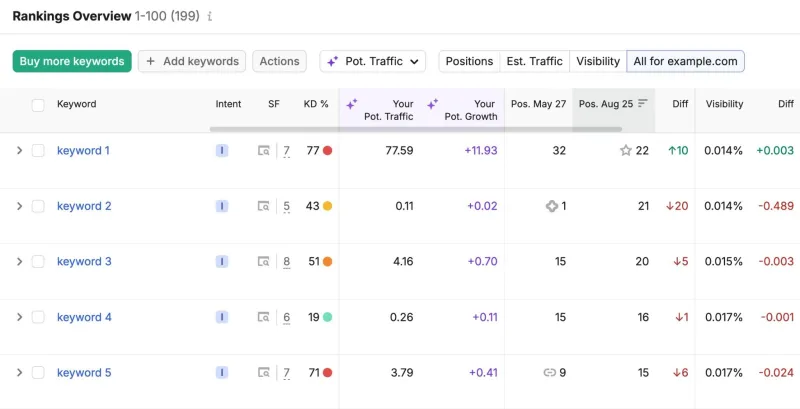
First step: compare periods before and after the update. A practical approach for initial analysis is to take 28 days before the update started and match them with 28 days after completion. If the site has low traffic volume, extend the window to six or eight weeks.
Check not just overall organic traffic but several metric layers:
- Impressions and clicks in Google Search Console. They show whether the site lost visibility or simply changed CTR.
- Average position by query group. Analyse branded, commercial, informational and geo-dependent keywords separately.
- Number of pages with clicks. A sharp drop in active URLs may point to indexing problems or algorithmic re-evaluation of specific clusters.
- Conversions and revenue. For affiliate projects, registrations, FTD, deposits, confirmed leads, CPA and revshare matter more than sessions.
- Traffic distribution by country and device. Sometimes the drop is limited to a specific GEO, mobile users or one language section.
Compare segments, not just the total line in the report. A 20% drop across the site may be caused by losing one informational cluster while money pages stay stable. Recovery strategy will differ from a situation where commercial pages dropped across all GEOs.
How to tell the update from a technical problem
Before any content changes, rule out technical causes. After August 21, check:
- Has the robots.txt file changed and are important sections now blocked.
- Are canonical tags, hreflang and page status codes still correct.
- Has the number of 4xx and 5xx errors grown.
- Have meta tag templates, internal links or URL structure changed.
- Is the site accessible to Googlebot and is it being blocked by CDN, firewall or anti-bot system.
- Has there been a migration, redesign, hosting change or mass page deletion.
Check server response time and mobile version load stability separately. In iGaming projects, technical changes often happen alongside updates to promo pages, odds tables, bonus blocks or operator widgets. That combination easily creates a false impression of algorithmic penalty.
Risk signals for affiliate sites
Google's algorithmic systems assess not one page but a set of signals. For affiliate projects, sites where commercial value is not backed by content are most vulnerable.
Mass pages targeting similar queries
If a site creates dozens of URLs with minimal differences in text, GEO, currency or operator name, those pages may be seen as a doorway approach. Simply swapping a country or brand name does not make a page independent and useful.
Each local page should have its own value: current terms, restrictions, payment methods, registration details, verification requirements and information confirmed at publication. Do not promise bonuses absent from the operator's landing page or hide material terms in the footer.
Content created for keywords
Keyword stuffing with phrases like 'best online casino', 'registration bonus' and 'no deposit bets' does not replace expertise. If text can be swapped for a template without losing meaning, its contribution to page quality is probably limited.
Useful material should answer real user questions: how the offer works, who can access it, what documents are needed, what withdrawal limits apply, what fees are charged and how one operator differs from another. That approach improves trust, CTR and conversion at once.
Weak editorial model
Risk increases if the site has no clear information about the editorial team, comparison methodology, update date and data sources. For operator reviews, disclosing the commercial relationship is important, and promotional claims should not be presented as independent facts.
Pay special attention to pages using AI-generated text. Using generative tools is not an automatic violation, but publishing a large volume of unchecked, uniform and unhelpful material may degrade site quality.
Manipulative links and redirects
Check paid links, PBNs, hidden links, mass anchor placements and redirects that send the user to a different offer without clear warning. In the gambling vertical, content swaps by GEO, device or referrer also occur. Such mechanics complicate diagnosis and may create additional risks for domain trust.
What not to do right after the update
Do not change titles, structure, text, links and templates all at once. With that approach you cannot tell what affected the result. First, record the data and compile a list of URLs with the most noticeable changes.
Do not delete pages just because of a temporary drop. If a URL lost positions but answers the query, has links and brings conversions, it makes more sense to improve it and observe over time. Mass deletion may reduce the site's overall topical relevance.
Also do not rely on a third-party 'penalty' indicator in an SEO tool. Such tools are useful for spotting anomalies but cannot see Google's internal systems or confirm the cause of a drop. If there is a manual action, the information will appear in Search Console; algorithmic change requires analysis of indirect signs.
Practical plan for the coming weeks
Build a table with URL, query cluster, GEO, page type, change in clicks, positions and conversions. Then divide pages into three groups: stable, dropped and grown. For each group, look for common traits: template, authorship, content type, number of external links, commercial load and last update date.
After that, run a spot check manually. Compare dropped pages with competitors in the results: how fully they answer the query, whether there is unique data, whether offer terms are clear, whether ads and pop-ups interfere with the main information. Check facts against primary sources, especially bonuses, licences, deposit and withdrawal methods.
Roll out changes in small iterations and log them: date, URL, edit type and expected effect. Judge the result after a few weeks, accounting for crawl and reindex lag.
The main conclusion after the August 2026 spam update is not to search for one cause of a drop but to check site quality as a system. For affiliate projects, sustainable SEO results are built on independent pages, honest offer presentation, verifiable data, transparent editorial model and control of technical signals. The update only reveals weak points; the team's job is to find them in the data and fix them without chaotic moves.


