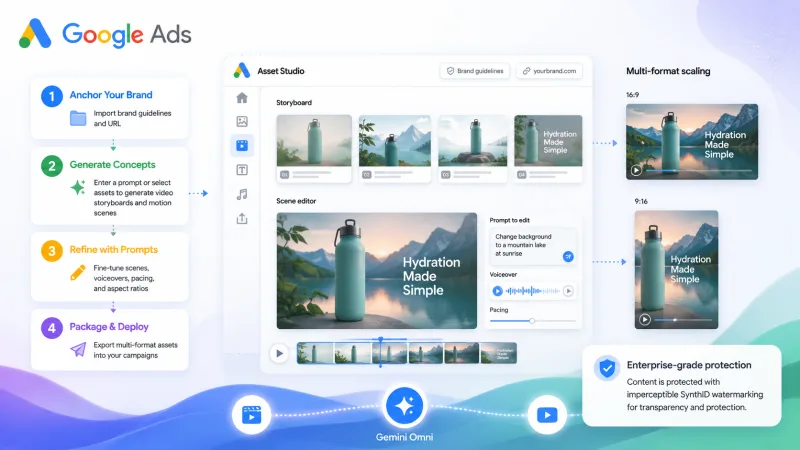
Google is integrating Gemini Omni into Asset Studio, allowing advertisers to generate campaign-ready video from creative briefs and brand assets. For performance teams in iGaming and affiliate marketing, where dozens of audience-offer-creative combinations need rapid testing, production speed directly affects ROI.
What changes in Asset Studio
Asset Studio is evolving as a workspace for ad preparation inside the Google Ads ecosystem. The Gemini Omni integration uses existing inputs: campaign descriptions, creative briefs, logos, images, and other brand materials. The output is video that can be refined and deployed.
The key value is not just frame generation. The process connects to existing ad infrastructure: assets are created with campaign use in mind, not as isolated experiments in a third-party service.
For teams this means faster transitions from brief to test, easier adaptation of one idea across formats and audiences, and a lower barrier for teams without dedicated video production. But speed of creation is not the same as quality of marketing decision. Gemini Omni can assemble video but does not automatically determine which offer will convert in a given GEO, how persuasive the call to action is, or whether the message meets platform requirements.
Why this matters for performance marketing
In traditional video production even a simple spot moves through several stages: task setting, scripting, material selection, editing, approval and export in multiple versions. If a campaign requires five or ten hypotheses, time and cost grow fast.
Generative tools change the economics of testing. Teams can assemble several concepts quickly and direct budget toward hypothesis validation rather than production of a single 'perfect' spot. This is especially relevant for traffic buying, where creatives have limited lifecycle and can burn out in days.
An affiliate team promoting an iGaming offer in CIS markets can prepare variants with different emphases: registration bonus, fast onboarding, tournament or seasonal promotion, mobile use case, brand trust and localized messaging. Each variant is then evaluated by CTR, registration conversion, FTD, player acquisition cost and final ROI. That approach is more useful than assessing a spot by visual appeal alone.
How to prepare data for generation
Result quality depends on input quality. A prompt like 'make a bright video for advertising' leaves too much room for random decisions. Before launching generation, turn the brief into clear instruction.
Minimum inputs include campaign goal (reach, traffic, registration, deposit or reactivation), target audience (GEO, language, device, product familiarity level), offer (what the user gets and under what conditions), key message (one main thought the viewer should remember), brand constraints (logo, colors, fonts, visual style and acceptable wording), placement requirements (duration, aspect ratio, subtitles and safe zones), and legal and platform restrictions (disclaimers, age limits and vertical-specific rules).
For iGaming it is especially important to check wording related to bonuses, winnings and probability of results in advance. A generative model may suggest striking but legally risky text. Final human review remains mandatory.
Brief for video: working template
Describe the task in this order:
- What is being advertised and what action the user should perform.
- Who the spot is for and in what language it will be shown.
- What offer needs to appear in the first seconds.
- Which visual elements are mandatory and which are forbidden.
- What the tone should be: restrained, dynamic, premium or playful.
- Which versions need to be prepared for testing.
This brief helps connect video to the funnel and business metrics, not just produce attractive animation.
Where generative video delivers maximum effect
The most obvious scenario is rapid creation of initial concepts. When the team does not yet know which visual angle will work, it is important to get several working variants with minimal time spent.
The second scenario is localization. For CIS markets adaptation of language, currency, visual codes and emphasis for a specific country may be required. The same offer is perceived differently in Kazakhstan, Uzbekistan, Armenia or Russian-speaking audiences in other GEOs. A generative tool can accelerate version preparation, but a local marketer must verify naturalness of text and cultural context fit.
The third scenario is remixing existing materials. If a brand already has images, product screenshots, banners and brandbook elements, they can be used as the basis for video. This preserves visual campaign integrity without starting production from scratch.
The fourth scenario is creative refresh when burnout occurs. Instead of a full campaign overhaul, change the opening seconds, scene order, offer presentation or end card. But simple background replacement does not always yield real lift: if the problem is a weak offer or wrong audience, new editing will not solve it.
What to check before launch
Any generated spot should be treated as a draft ad asset, not a final result. Before publishing, run through a short checklist: logo and brand name display correctly, no errors in text, figures, currency or translation, offer is readable on mobile screen, call to action is clear without sound, first seconds are not overloaded with detail, promise in video matches landing page content, disclaimers comply with GEO and platform rules, faces, hands, interfaces and other details that generative models sometimes distort look correct, and no rights violations on images, music or characters used.
Separate attention goes to tracking. If video launches in Google Ads, campaign parameters, events and postback must be configured before testing begins. Without this the team will see CTR but will not understand whether the creative brings quality traffic and how it affects CPA, ROAS or revshare.
How to embed Gemini Omni in testing workflow
The optimal scheme starts not with generating dozens of spots but with a hypothesis matrix. First, audience segments, key messages and offer variants are fixed. Then a limited number of videos is created for each combination.
For example, test three messages for one GEO and two visual styles. That yields six variants. The first stage evaluates attention retention and CTR, after which weak versions are turned off. The second stage compares registration conversion, FTD and cost per target action. This two-stage approach prevents decisions based solely on top-level metrics.
Keep a test log: save brief, spot version, launch date, budget, audience and result. After several cycles the team accumulates a library of working patterns. This allows using Gemini Omni not as a random generator but as a tool for systematic creative production.
Limitations and risks
Generative video accelerates production but does not guarantee originality, accuracy or conversion. The model may misinterpret brand elements, create a visual detail absent from the product, or suggest overly aggressive presentation. For regulated verticals this is especially sensitive.
There is also a risk of uniformity. If advertisers use similar prompts and assets, the feed quickly fills with visually identical spots. So advantage will go to teams that add their own data: real audience insights, results from previous tests, local observations and clear communication strategy.
The practical takeaway: Gemini Omni in Asset Studio shortens the production cycle and makes video testing more accessible. But the result is still determined by the combination of correct brief, strong offer, quality tracking, manual moderation and discipline in analysis. The tool helps ship hypotheses faster, and the marketer's job is to select the ones that create measurable ROI growth.


