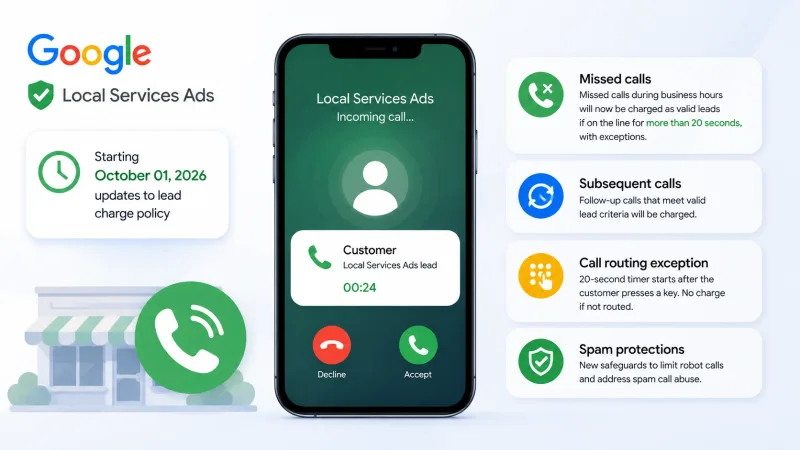
What changes in Local Services Ads
Starting Oct. 1, Google will charge Local Services Ads advertisers for some missed and follow-up calls. Not every unanswered ring triggers a fee, only those the system classifies as valid leads.
The shift matters for businesses that rely on phone calls: local service providers, medical practices, law firms, repair shops, cleaning services and others with high call-to-conversion ratios. Previously an advertiser could treat a missed call as a non-event. Now some of those inquiries may be billed.
For performance marketers it means one thing: cost per lead increasingly depends not just on bid and CTR but on how well incoming traffic is handled.
Which calls count as leads
The key criterion is whether the inquiry meets Google's definition of a valid lead. A missed call does not automatically mean you pay. But if the call related to a service you offer, fell within the right category and met platform rules, it may be counted regardless of whether someone picked up.
Follow-up calls require attention. A customer may call back minutes or hours later if they got no answer, wanted to clarify details or continued discussing an order. Those calls can also be classified as part of a qualified lead.
Practical takeaway: you cannot judge campaign performance by talk time or answered calls alone. Reporting should break out incoming calls, missed calls, follow-up calls, leads Google classifies as valid, the share of off-target or accidental dials, and cost per lead based on what is actually billed.
The exact classification logic depends on Google's rules and campaign settings. Check your account terms and Local Services Ads reports before adjusting budgets.
Why this affects ROI
For an advertiser a call is not the final conversion, just the start of lead handling. If the team does not answer, ad spend keeps bringing potential customers but the business loses the chance to close.
Consider a local appliance repair shop. It gets 30 calls a week during business hours, six go unanswered. Before, some of the team might not count those inquiries when calculating effectiveness. Under the new rules those six missed calls may raise costs if Google deems them valid leads.
Several metrics shift at once: actual CPL may exceed projections, ROI falls if missed leads never re-enter the funnel, ROAS becomes less informative without tracking operational conversion to sale, a campaign may look strong on lead volume but weak on revenue, and channel comparison requires a consistent attribution method.
For businesses it is another reminder: advertising and operations cannot be split. If Google delivers calls, answer speed and call-centre quality become part of ad economics.
What to check before Oct. 1
1. Schedule and staff availability
Review business hours in the profile, actual manager presence and shift allocation. If ads run when no one takes calls, the likelihood of missed inquiries rises.
For local businesses the danger zones are morning hours, lunch breaks, weekends and high-load periods. The formal schedule in the listing must match real team availability.
2. Call routing
Make sure calls are not lost during forwarding, switching between numbers or virtual telephony. Check the backup number and the scenario when the main operator is busy.
Run a series of test calls from different numbers and at different times. Confirm that a customer reaches a person quickly and that a missed call is logged in the CRM or phone system.
3. Callback speed
If answering immediately is not possible, automated follow-up becomes critical. Even a short message confirming the inquiry and promising a callback reduces the risk of losing the customer.
The optimal process should include notifying the responsible employee, monitoring response time and attempting contact again. In B2B and iGaming segments this is especially important: some leads switch offers, sources or suppliers quickly, so a delay of a few hours can cost a deal.
4. Category and profile accuracy
Check whether the profile matches actual services, geography and operating hours. An incorrect category can attract off-target inquiries and degrade traffic quality.
Advertisers should regularly analyse which calls lead to sales and which arise from mistaken user expectations. If some inquiries clearly do not match the service, revise the description, settings and profile elements.
How to adjust analytics
Before the updated rules take effect, lock in baseline metrics for a few weeks: number of calls, share of missed calls, follow-up inquiries, CPL, conversion to qualified lead and revenue.
Separate marketing conversion from operational conversion. The first shows how many inquiries the ads created. The second shows how many were handled and taken to the target action.
A minimal control table might look like this:
| Metric | What to track |
|---|---|
| Incoming calls | Total calls from Local Services Ads |
| Missed | Calls with no operator answer |
| Follow-up | Repeat calls on an inquiry |
| Valid leads | Inquiries Google counts |
| CPL | Spend per lead |
| Sales | Deals closed after a call |
| Revenue | Income attributed to inquiries |
This approach clarifies where the problem lies: traffic, Google classification, telephony or sales.
How to cut losses
Reducing missed calls usually delivers faster results than raising budget immediately. Start with simple changes: assign shift owners, turn on notifications, set up a backup line and introduce a standard for re-contact.
If call volume is high, a call queue, call tracking and CRM integration help. But do not stop at counting pick-ups. Monitor the share of qualified inquiries, response time and the percentage of customers who reach the next funnel stage.
For smaller companies it makes more sense to identify peak demand hours and ensure stable coverage then. There is no point expanding ad delivery during periods when the team physically cannot handle the inbound flow.
Main takeaway for advertisers
Starting Oct. 1 a missed call in Local Services Ads will not always mean zero ad cost. If the inquiry meets valid-lead criteria, Google may include it in billable stats along with follow-up calls.
Before the rule change, check schedule, routing, CRM, callback speed and CPL calculation method. Judge a campaign not by call count but by the chain of impression, inquiry, handling and sale. The more reliable that chain, the smaller the impact of the new charges on ROI and the more accurate the decision to scale budget.


