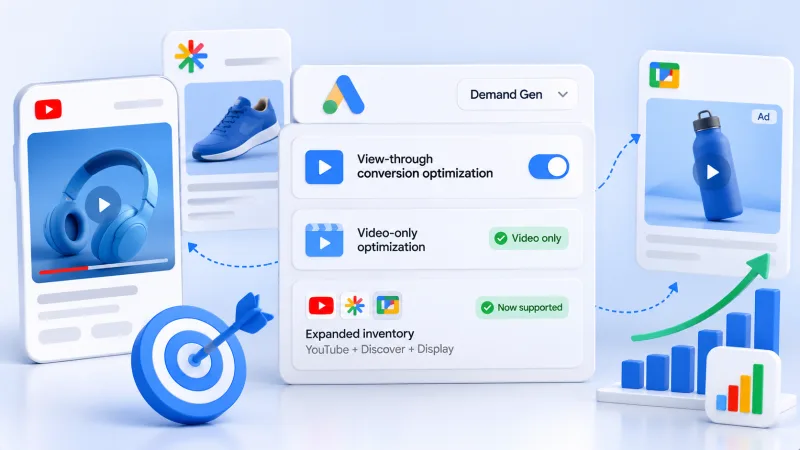
Google has updated view-through conversion optimization in Demand Gen campaigns, making it video-only while expanding support to Display. For affiliate teams, iGaming brands and performance agencies running traffic on Google, this is not a cosmetic change.
View-through conversion happens after a user sees an ad but converts later without clicking — through search, direct visit, or another channel. The algorithm now treats video separately in Demand Gen, while Display gets view-through optimization as a new performance layer. That shifts how budget flows, which creatives scale, and how attribution inflates or understates real ROI.
Why view-through matters in iGaming
Between first touch and FTD, a user often compares brands, checks reviews, evaluates deposit methods, and returns via SEO or direct entry. If you only count last click, video and Display are undervalued. If you count every view-through without discipline, ROAS looks good on paper while payout economics deteriorate.
For CPA offers, the gap is sharper. The ad cabinet may show rising view-through conversions while the affiliate network reports flat approvals. Advertisers cut low-quality or incentivized traffic regardless of what Google attributes to the campaign. For revshare, view-through can be more useful since the model values brand demand over immediate clicks, but cohort analysis still decides: which users converted after video contact, how much did they deposit, what LTV did they deliver at 7, 14 and 30 days.
What changed in Demand Gen
Demand Gen historically targeted visual demand across YouTube, Shorts, Discover and Gmail, where users are not ready for an immediate click. View-through optimization made sense there. Now Google restricts it to video formats only, where viewing the creative is a meaningful engagement signal.
Practical outcome: if your Demand Gen mixes video and static assets, view-through optimization no longer applies universally. Video earns a distinct role in the funnel. Static formats have to prove value through clicks, post-click conversions and supporting metrics. The 'banner plus wide view-through plus aggressive deposit optimization' setup becomes less predictable. Video creatives gain more weight as first-contact tools, especially in niches with long warmup: betting, casino, sweepstakes, crypto gambling, fantasy sports.
Why Google is expanding view-through to Display
Extending view-through optimization to Display looks like an attempt to strengthen the banner network's role in performance funnels. Display has long been used for remarketing, warming users back to registration or deposit, and returning abandoned funnels.
For Google, it also gives the algorithm more signals. If certain impressions correlate with later conversions, the system can shift budget toward audiences, placements and creatives that participate more often in the path to action. But Display inventory is uneven — from quality publishers to low-attention placements. In affiliate and iGaming, a banner may reach an audience that fits interest targeting but has no real intent to register or deposit.
View-through in Display should supplement CPA logic, not replace it. The question is not how many conversions appeared in the cabinet, but whether economics improved by CRM, MMP, postback and actual deposits.
How to adapt campaign structure
First, check attribution windows. A view-through window that is too long inflates ad contribution. For iGaming, where users take time choosing a brand, this is tempting but dangerous. Start conservative and compare results against control periods.
Second, choose the optimization event carefully. If volume allows, pass higher-quality events: FTD, qualified deposit, repeat deposit, minimum net revenue. If data is scarce, you can use registration but must separate it from revenue KPIs.
Third, segment video and Display. Do not treat them as one management unit. Video in Demand Gen works for warmup and demand creation. Display works for re-engagement and return. They have different roles, different creatives, different expectations for CTR, CPA and ROAS.
Fourth, tighten exclusions and brand safety. For iGaming this matters not only for traffic quality but for compliance. Check placements, content categories, age restrictions, local GEO rules and offer constraints.
Fifth, import offline conversions and postbacks. The more accurate the signal Google receives about real user quality, the lower the risk of optimizing toward cheap, useless actions. If the affiliate programme can pass lead status, deposits or value, use it.
Creative adjustments
Video for Demand Gen should explain offer value quickly. In iGaming that does not mean shouting about the bonus in the first two seconds. Better: recognizable scenario, concrete advantage, clear next step. Fast payouts, local payment methods, live betting, tournament mechanics, welcome package without fine-print overload.
For view-through, memorability matters. The user may not click immediately but should remember which brand they saw and why they should return. Video needs a visible brand signal, clear visual rhythm, one main message. Five offer advantages in one clip usually lower conversion because the audience retains none.
Display creatives should be simpler: high contrast, testable by hypothesis. Bonus, payment method, sports event, local insight, abandoned registration return. For CIS and neighboring GEOs, creatives tied to a concrete event often work well: major football match, esports tournament, local payment habit. But such hooks need fast updates or CTR drops while the algorithm keeps buying impressions by inertia.
Measurement without self-deception
The main mistake is looking only at conversions inside Google Ads. After view-through expansion, numbers may look better because the system counts more impression contributions. That does not always mean the business earned more.
Minimum checks: compare post-click and view-through conversions separately; reconcile CPA in the cabinet with actual CPA by affiliate network or CRM; assess FTD share, not just registrations; evaluate ROAS by cohort, not by click or impression day; compare branded search uplift before and after video launch; run a holdout test if budget allows.
For arbitrage teams, maintain a separate table by setup: GEO, offer, format, attribution window, spend, registrations, FTD, approval rate, payout, ROI. View-through conversions deserve a separate column so they do not blend with click events.
If registrations rise after enabling view-through but deposits do not, the problem may be weak alignment between creative and landing page. The user remembered the promise, returned later, but found different terms on the landing, complicated registration or unsuitable payment method. In iGaming such details kill conversion fast.
Action plan
For current Demand Gen campaigns, separate video and non-video assets in analytics first. Check which conversions follow views, what their path to FTD looks like, and whether the attribution window overstates video contribution. If video genuinely influences quality deposits, allocate separate budget and test different first 3-5 seconds, offer angles and frequency caps.
For Display, do not turn on view-through optimization across the entire budget at once. Start with a limited test on a known GEO and offer where postback is stable. Compare not only CPA but approval rate, average deposit, repeat deposits and advertiser complaints about quality.
Check separately which events are imported into Google Ads. If the system optimizes for too early an action, it will find cheap top-of-funnel traffic, not profitable players. Ideally pass value-based signals: deposit, net revenue or at least qualified FTD.
Do not treat view-through as free performance uplift. It is a way to account for impression influence, but it requires attribution discipline. In the hands of a team with solid end-to-end analytics, the update can help scale video and Display without losing control. Without reconciliation against actual payouts, deposits and LTV, it easily becomes a pretty report with questionable ROI.


