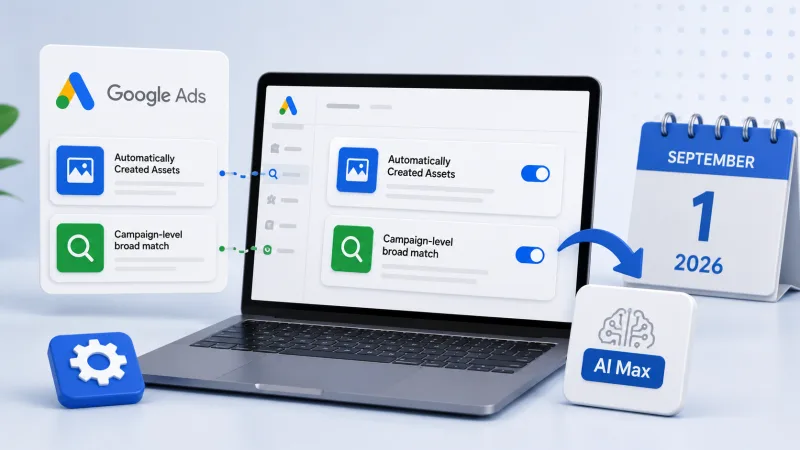
From September 1, Google will auto-upgrade eligible Search campaigns from automatically created assets to AI Max. This is more than a rebrand. Google is expanding the role of AI in search term matching and ad text generation, and in performance marketing those changes demand oversight.
What AI Max does
AI Max is a set of AI features for Google Ads Search campaigns that builds on standard Search. The two core functions are search term matching and text customization. The system gets more latitude in where to show the ad and what text to show the user.
For accounts with solid conversion history, clean structure and accurate value tracking, that can unlock reach and conversions. But for verticals with tight restrictions — iGaming, betting, finance, nutra — more automation means more control work.
The risk is not AI Max itself. The risk is noticing too late which queries, texts and landing pages are driving the funnel.
What the auto-upgrade changes
Campaigns already using automatically created assets will gain AI Max features without manual activation. Google will draw more actively on landing page content, existing ads, keywords and campaign signals to generate variants.
That affects several working areas:
- Query matching: the system may surface additional search phrases close to user intent, even if those terms are not in the account.
- Ad text: headlines and descriptions adapt to the specific query and context.
- Semantic control: negative keywords, brand safety and regular search term audits become more important.
- Analytics: watch not just CPA but lead quality, postback, deposits, FTD, retention and LTV.
For affiliate teams, cheap leads do not always mean profitable traffic. Rising CTR can accompany falling audience quality.
Opportunity for affiliate and iGaming teams
When a campaign is set up carefully, AI Max can find additional demand segments. A user may search not for the casino brand directly but for phrases like 'casino with fast withdrawal', 'bookmaker with freebet today', 'slots without verification'. Building those long-tail clusters manually takes time, and some queries stay outside the base semantic core.
AI Max can strengthen campaigns where:
- there is a large volume of historical conversions;
- the landing page reflects the offer and geo accurately;
- the account tracks goals by value, not just by submissions;
- negative keyword lists and brand exclusions are in place;
- creatives and copy comply with moderation requirements.
For iGaming this can help scale whitehat funnels, reviews, comparison pages, SEO bridges and branded alternatives. But if a campaign operates close to the compliance edge, caution is due. AI may generate phrasing that looks too aggressive for Google policy or does not match the rules of a specific geo.
Risk zones: semantics, text and offer fit
Automation works well when the input data is sound. If the landing page is loaded with generic promises, old ads are written chaotically and Google Ads goals track shallow events, AI Max will optimize on weak signals.
Main risks:
- Irrelevant traffic. The campaign may expand into queries with high CTR but low deposit or purchase intent.
- Rising spend without rising profit. CPA may look acceptable while ROAS and revshare drop.
- Moderation issues. In sensitive verticals, AI-generated text needs careful review.
- Positioning blur. If the system inserts overly general phrasing, the ad stops filtering non-target audiences.
- Attribution complexity. With broader matching, you need to know which search terms actually deliver FTD, sales or qualified registrations.
For the affiliate manager or media buyer, the principle is simple: AI Max is a scaling tool, not a strategy layer.
Preparing the account before September 1
First, audit Search campaigns where automatically created assets are enabled. Identify which campaigns may be auto-upgraded and whether they are ready for expanded automation.
Practical checklist:
- Check conversion goals. The account should track not only registrations but more valuable events: deposit, qualified lead, purchase, approval. Where possible, pass value through offline conversions or postback.
- Update negative keywords. Remove low-intent queries — 'free', 'download', 'scam', 'fraud reviews' — if they do not fit your strategy. For iGaming, separately review queries linked to minors and prohibited terms.
- Clean up landing pages. AI will lean on page content. If the landing shows outdated bonuses, wrong geos or questionable claims, the system may use them in ad text.
- Check brand controls. If you cannot show on competitor brands or certain operators, set restrictions in advance.
- Split campaigns by risk. Do not mix stable branded traffic, generic queries and test funnels in one structure. That makes it easier to assess AI Max impact.
Capture your baseline before the upgrade: CPA, CTR, conversion rate, ROAS, share of branded traffic, lead quality and affiliate programme revenue. Without that, you will struggle to tell whether results improved or traffic simply grew.
Controlling AI Max after launch
Do not judge AI Max by the first few days. Algorithms need time, but that does not mean budget runs unsupervised. Best practice is daily monitoring in the first week, then regular slices of search terms and conversions.
Watch these metrics:
- Search terms: which new queries appeared and how well they match the offer.
- CPA and ROAS: not just averages but breakdowns by campaign, geo and device.
- Conversion quality: approval, FTD, deposit, retention, returns, cancellations.
- CTR vs CVR: rising click-through without rising conversion may signal text that is too broad or too promising.
- Spend on new segments: AI expansion should not eat budget from profitable keywords.
If you work with CPA networks or direct advertisers, reconcile Google Ads data with your tracker — Keitaro, Binom, RedTrack, Voluum or internal BI. Google optimizes on what it sees. Partner profit often lives deeper in the funnel.
What to do now
AI Max is the logical next step in Google's Search automation push. For strong accounts, it is a chance to pull additional demand and speed up tests. For weak accounts, it risks scaling errors in structure, analytics and content.
Before the auto-upgrade, do three things: audit campaigns, clean up conversion signals and set control rules. In affiliate marketing, the advantage goes not to those who simply switch on AI features but to those who can quickly separate profitable expansion from wasted spend.
AI Max does not replace the media buyer. It shifts the focus: less manual query work, more control over data, traffic quality and offer economics.


