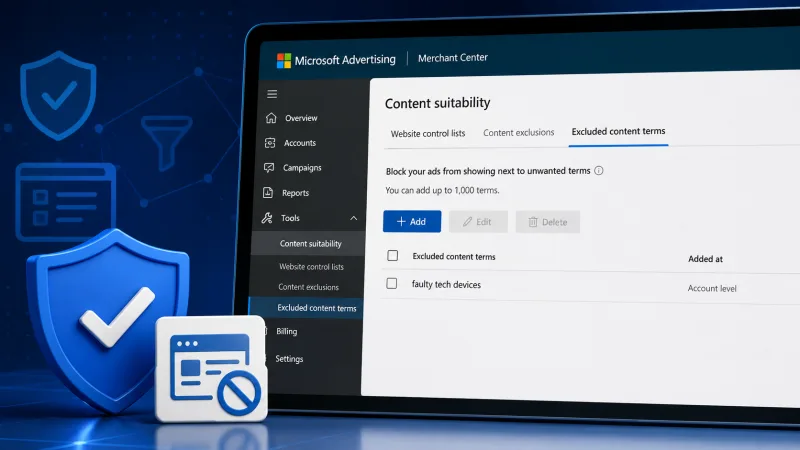
Microsoft Advertising now allows advertisers to block Audience Ads from appearing alongside pages whose titles contain specific words or phrases. The feature is called excluded content terms and gives advertisers direct control over brand safety at the placement level.
For affiliate teams, iGaming brands and performance agencies, this is not just another filter. It helps manage context, reduce reputational risk and scale native formats without accidentally placing ads next to damaging content.
How excluded content terms work
Audience Ads appear in native placements across Microsoft's ecosystem: MSN, Outlook, Microsoft Edge and partner inventory. The new setting blocks impressions when the page title contains terms specified by the advertiser. If a brand wants to avoid appearing next to news about bankruptcy, fraud, tragedy or regulatory enforcement, it can add those words to the exclusion list.
The filter reads page titles, not full article text. It is not a semantic safety scanner, but for most scenarios it works because titles reflect the main topic and get indexed fastest by ad systems.
Why it matters for affiliate and iGaming
In iGaming and affiliate marketing, controlling ad environment is often more critical than in e-commerce. Advertisers work with sensitive categories, payment restrictions, local regulation and strict partner programme requirements.
A typical scenario: a team runs traffic to a casino offer in a permitted GEO, uses Audience Ads for reach and gets solid CTR. But some impressions appear next to headlines like 'gambling addiction', 'bookmaker fined', 'online casino ban', 'bonus fraud'. Even when the ad itself is compliant, that context can damage brand perception and lower traffic quality.
For CPA networks and media buyers, this creates three risks: conversion drop due to negative context, complaints from advertisers about unsuitable placements, and wasted spend on impressions that attract the wrong audience.
Excluded content terms do not solve all of this automatically, but they add a layer of control on top of targeting, domain exclusions and brand safety settings.
Which words to exclude
The main mistake is adding too broad a list and killing volume. If you block every controversial word, the campaign can lose significant inventory, especially in news environments. Build the list based on risk, not guesswork.
For iGaming, betting, fintech and high-risk verticals, start with a few categories: negative legal context (fine, court, investigation, arrest, ban, illegal, licence revoked), fraud and scam (scam, fraud, fake, data breach), addiction and social risk (addiction, gambling disorder, debt, self-exclusion), tragedy and emergencies (death, accident, disaster, war, attack), politics and sanctions (sanctions, elections, protests, corruption, regulator).
For teams working several languages, make the list multilingual. If the campaign targets Kazakhstan, Uzbekistan or Georgia, where user content mixes Russian, English and local languages, add at least Russian and English variants of key risk terms.
Not every alarming word is equally harmful. The word 'bet' appears in financial news, sports analysis and betting content. If you are driving traffic to a sportsbook, excluding it entirely may remove relevant placements. The same applies to 'casino', 'bonus', 'tournament', 'jackpot'. Segment by offer: what makes sense to exclude for a soft gaming app may be relevant context for a direct casino brand.
How to implement without losing scale
Work in stages. In performance marketing, any setting that limits inventory should be tested, or you risk improving placement quality while destroying ROI.
Recommended process: gather a starter blacklist of 20 to 50 terms with the highest reputational risk; split campaigns by offer type (casino, betting, finance, sweepstakes, nutra, dating); do not apply one list to all campaigns; compare before and after on CTR, CPC, CPA, CR, ROAS and impression volume; check not only CPA but lead quality (approval rate, FTD, deposit, retention, revshare LTV).
If CTR drops slightly after adding exclusions but CPA improves, that is normal: you removed emotionally charged placements that converted poorly. If both volume and conversion drop, the list is too broad or you blocked relevant topics.
Link to SEO and content analytics
Excluded content terms can be built not just from ad reports but from SEO analytics. If the team runs content projects, PBNs, review sites or brand search monitoring, it already has data on topics that bring toxic or irrelevant traffic.
For example, SEO data shows that queries containing 'scam', 'won't withdraw money', 'account blocked' attract informational traffic but almost no deposits. Those same terms can be tested as exclusion candidates in Audience Ads.
For affiliate teams, combine three sources: search queries from SEO and paid search, page topics where conversion was historically low, complaints or comments from advertisers about placement quality. The blacklist becomes a working optimisation tool, not a subjective list of unpleasant words.
Where the filter does not replace manual control
Excluded content terms are useful but not a full defence against low-quality inventory. The filter works on titles, so it can miss pages where controversial topics appear in body text but not in the headline. The reverse is also possible: a title may contain a risky word in neutral or positive context.
Use the filter alongside other control layers: domain and site exclusions, proper audience segments, negative keywords and topic restrictions where available, UTM tagging and post-click analytics, regular review of placement reports, separate campaigns for different GEOs and languages.
For iGaming, do not mix GEOs with different regulatory environments. If the same exclusion list is used for Tier 1, LATAM and CIS, it quickly becomes too soft or too strict. Run separate term sets for key markets.
How to measure impact
After implementing excluded content terms, look beyond top-of-funnel metrics. Brand safety settings rarely deliver instant CTR growth. Their job is to remove bad context and make traffic more predictable.
Minimum metric set: impressions (how much available inventory shrunk), CTR (whether first-contact quality changed), CPC or CPM (whether buying cost increased), CPA (whether target action became cheaper), post-click CR (whether users convert better after the click), FTD or deposit for iGaming, ROAS or ROI at campaign and offer level.
Control questions for media buyers: which terms actually affected volume and which barely touched the campaign; is there a difference between mobile and desktop placements; did traffic quality improve according to the affiliate programme, not just the ad dashboard; did we block relevant sports or entertainment contexts; do we need different lists for brand, generic and competitor creatives.
Good practice is to review the exclusion list every two to four weeks, especially if the campaign is scaling or the news agenda in the GEO is shifting.
What it means for the ad market
Adding excluded content terms reflects a broader trend: ad platforms are giving advertisers more granular brand safety controls inside performance tools. Previously, similar mechanics were associated with large display buys where GRP, reach and reputational KPI mattered. Now they are part of daily work for CPA teams.
For affiliate marketing, this is a positive signal. The more control over context, the easier it is to build long-term relationships with advertisers, protect budgets and explain traffic quality not just by CPA number but by the environment in which the user saw the creative.
Practical conclusion: add excluded content terms to the standard checklist for launching Microsoft Audience Ads. Start with a short list of critical terms, then expand based on data. In verticals like iGaming, betting, finance and dating, this approach helps not just clean up impressions but manage ROI more consistently over time.


