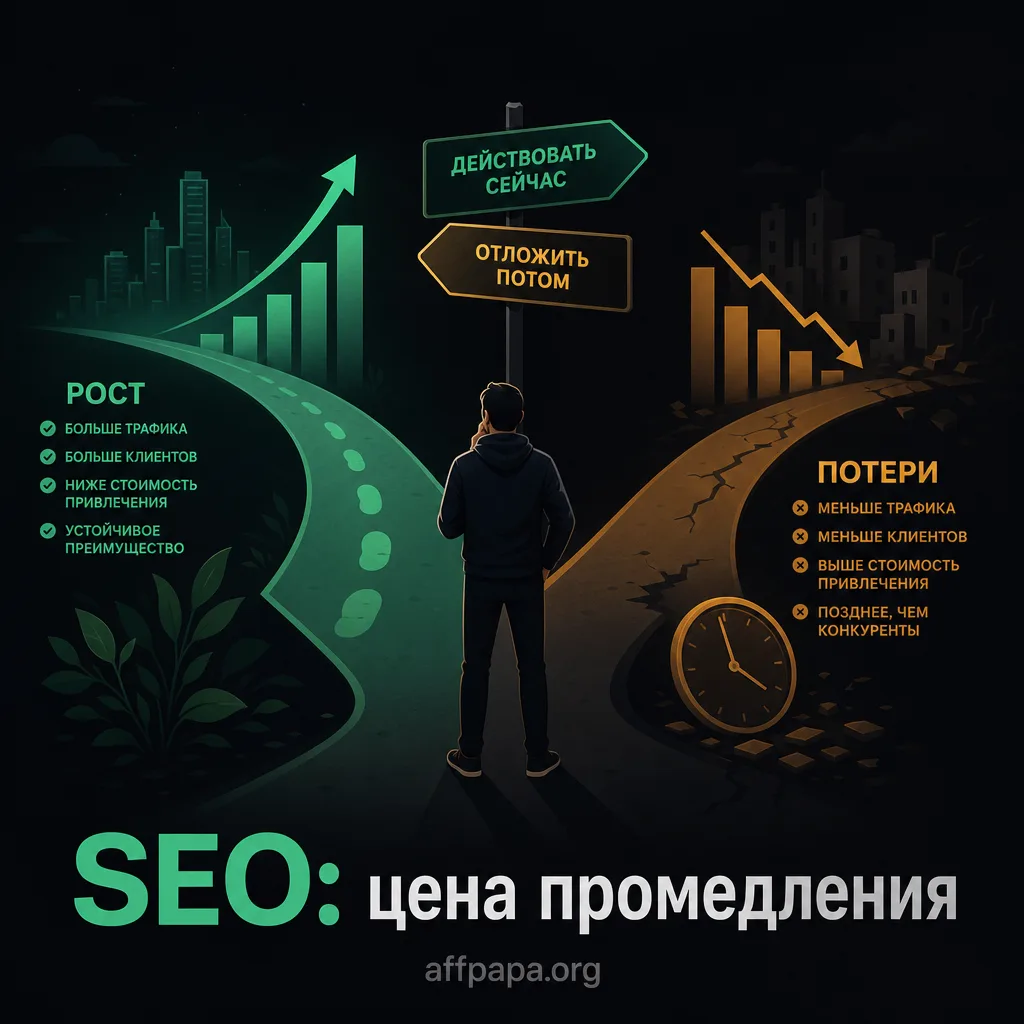
When the market shifts, many companies freeze SEO budgets and wait to see what happens next. The logic seems sound: why invest in a channel when the rules are changing? The problem is that SEO does not pause with your budget.
While teams wait, competitors update content, strengthen E-E-A-T signals, capture backlinks, test new snippet formats and claim positions in SERPs that will later cost more to reclaim. For iGaming, affiliate marketing, fintech and other competitive verticals, a wait-and-see approach is not caution — it is hidden debt that accumulates slowly but hits visibility, domain authority, CPA and ROI hard.
Why SEO cannot simply be paused
SEO is not an ad campaign you can switch off and restart a month later with the same results. Search optimisation works through signal accumulation: content, technical health, behavioural factors, link profile, update frequency, brand trust.
When work stops, degradation begins. Pages become outdated and lose relevance. Competitors intercept intent and expand semantic coverage. The link profile ages and some links drop off. Technical errors accumulate after releases. Google and Yandex receive fewer signals that the site is alive and useful. The team loses focus, process and expertise.
This hurts most in verticals where SERPs shift quickly. Queries like 'best online casinos Kazakhstan', 'bookmakers with fast withdrawal', 'casino no verification' or 'no deposit bonus' are regularly updated by competitors. If your page has not changed in six months while a competitor has fresh offer terms, current payment methods, FAQ and structured data, the search engine finds it easier to trust them.
The hidden cost: what the business actually loses
On the reporting level, an SEO pause may look harmless. Budget is cut, expenses are lower, organic traffic holds for now. But the real cost shows up later.
Loss of search visibility
Positions rarely drop all at once. Usually long-tail coverage declines first, then secondary clusters weaken, then commercial queries suffer. In affiliate this is especially dangerous because long-tail often delivers the cheapest and highest-quality conversions.
Not the broad query 'online casino', but more precise ones: 'casino withdrawal to Mir card', 'bookmakers with freebet for registration', 'crypto casino no KYC', 'best CPA networks for gambling'. These queries may not look impressive by volume, but they sit closer to registration or deposit. Losing these tails raises average CPA because the business has to make up leads through paid traffic.
Weakened domain authority
Authority is not just DR or DA in SEO tools. It is the sum of trust a search engine places in a site: who writes the content, how expert it is, whether other resources link to it, whether materials are updated, whether there is conflicting information.
In YMYL and near-YMYL topics — which partly include finance, betting and iGaming — trust is critical. If a site stops publishing expert materials, stops updating brand reviews, shows no clear editorial policy, does not improve author pages, it gradually loses to those investing in E-E-A-T.
Loss of pace and data
SEO is not only positions but constant learning. Which clusters are growing? Which snippets give better CTR? Which pages appear in AI answers? Where does Google rewrite titles? Which intents shift after an update?
When work is frozen, the business loses data. Without data it is harder to make decisions on content, product and traffic acquisition. After six months of pause, the team returns not to the same point but to a new reality without fresh analytics.
AI search is not a reason to freeze SEO but a reason to rebuild it
One main reason companies choose to wait is the development of AI in search. If users get answers directly in results, why invest in content?
In practice AI does not cancel SEO but changes its requirements. Search engines and AI models still need sources. Winners are not those who write more but those who provide structured, verifiable and expert answers.
What matters more now: content with clear expertise, not rewritten generic articles; structure convenient for fact extraction — tables, FAQ, lists, definitions; brand signals like mentions, authors, citations, reputation; updateability with dates, current terms, fresh examples; unique data from studies, cases, comparisons, internal observations.
For an affiliate project this means an offer review should not be just an 8,000-character SEO text but a useful page with terms, geo, payment methods, limits, pros and cons, real scenarios for the webmaster or player.
How to continue SEO without inflating the budget
If the market is unstable, you do not need to increase investment. But it is important not to switch off the process entirely. Below is a practical minimum plan that helps preserve visibility and maintain pace.
Audit pages that already bring revenue
Start not with new articles but with what already affects revenue. In affiliate these might be casino and bookmaker ratings, CPA network reviews, pages for specific geos, offer comparisons, pages with high conversion to registration or FTD, pages that get organic traffic but have low CTR.
Divide them into three groups: defend — pages with traffic and revenue you cannot lose; update — materials with position drops or outdated data; strengthen — pages in positions 5 to 15 where a small update can bring quick growth.
Often updating 20 strong pages delivers more effect than publishing 50 new materials without strategy.
Update content for intent, not volume
The old approach of adding 3,000 more characters works worse. The search engine evaluates whether the page answers the user's task.
Check: does the title match current SERPs; is there a quick answer in the first screen; are commercial offer terms disclosed; is there current FAQ; is there comparison with alternatives; do data in different parts of the page conflict; is the update date indicated.
If a page ranks for 'best casinos with fast withdrawal', the user needs not general talk about licences but a table: brand, average withdrawal time, limits, available methods, whether verification is needed, minimum deposit.
Monitor technical foundation
Technical SEO often suffers first when budgets are cut. But technical problems can quietly consume organic traffic.
Minimum checklist: indexation of important pages, no accidental noindex or canonical after releases, load speed and Core Web Vitals, correct mobile version, clean URL structure, no duplicates from filters and pagination, schema markup for FAQ, Review, Organization, Article, correct hreflang for multilingual projects.
For iGaming affiliates with multiple geos, hreflang and canonicalisation are especially important. An error in locales can lead to a page for Kazakhstan competing with a page for Uzbekistan or Russia.
What to do with links and brand during uncertainty
Link building also cannot be abruptly zeroed, especially in competitive SERPs. But it can be made more precise.
Instead of mass link buying, focus on quality: placements on niche media and portals, expert columns, brand mentions without direct anchor, partner studies and ratings, PR around proprietary data, links to pages already close to the top.
Important: in AI search and modern results, brand mentions become almost as important as classic backlinks. If your project is often cited as a source on CPA, gambling, payment methods or ad networks, it strengthens trust.
How to measure effectiveness when clicks decline
One challenge of new search is that organic traffic may grow slower than visibility. Users sometimes get answers directly in results and CTR falls. So evaluating SEO only by clicks is no longer enough.
Add to reporting: share of queries in top 3 or top 10, visibility for priority clusters, CTR by page type, conversions and revenue by URL, assisted conversions, brand demand, share of organic in FTD, registrations and leads, positions in SERP features and AI blocks if data is available.
For affiliate projects it is especially important to look not only at traffic but at EPC, CR and revenue per page. An article with 300 visits and high FTD can be more valuable than an informational piece with 10,000 visits and no conversion.
Minimum SEO strategy during turbulence
If large-scale promotion is not possible, maintain at least a basic rhythm. It helps you stay in the race.
Practical monthly plan: update 5 to 10 commercially important pages, close critical technical errors, publish 2 to 4 expert materials for growing intents, obtain several quality mentions or links, rebuild internal linking between money pages, check snippets and CTR in Search Console, update schema markup, analyse competitors in the top for key clusters.
This does not require a huge budget but keeps movement going. In SEO, movement is often more important than a perfect forecast.
Conclusion
A pause in SEO rarely looks dangerous in the moment. It becomes expensive later — when positions are already taken by competitors, content is outdated, links have weakened, and paid traffic has to be bought at higher cost to compensate for organic collapse.
The right approach during uncertainty is not to wait until everything clears up but to redistribute effort: defend profitable pages, update content for real intent, strengthen technical foundation, develop brand signals and measure SEO through business metrics.
Search is changing. But that is exactly why those who adapt in process win, not those who return after a pause to find the results already divided without them.


