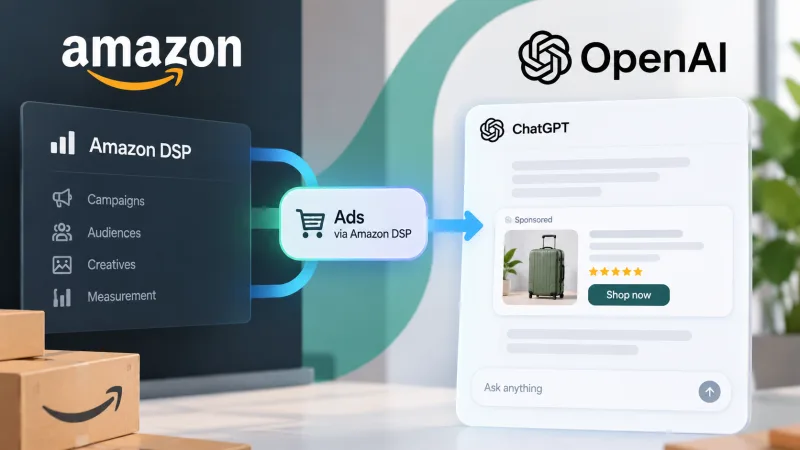
Amazon has launched pilot access to ChatGPT Ads through Amazon DSP for U.S. advertisers. The programme allows DSP campaigns to extend into conversational ad formats inside ChatGPT.
For performance marketers, this shifts the usual purchase logic. The ad contact happens not on a search page or standard feed but inside a dialogue with the user. Attention is tied to a question or intent the person has already expressed in the chat.
This remains a pilot. Amazon is testing access to new ad inventory, not announcing a full rollout across all markets and business categories.
How the ad contact changes
In the standard DSP model, an advertiser buys impressions across available placements through unified infrastructure. The user sees a banner or video while visiting a site or app.
ChatGPT Ads work in a different environment. The user enters a dialogue and describes a task in words. An ad message in that context may appear alongside an answer or recommendation tied to a specific need. That changes the role of context: not just audience segment but the content of the query matters.
For marketers, this introduces a new variable. The same user may be interested in different products at different moments, and intent is read through the topic of conversation. Familiar divisions by demographics or interests may now be supplemented by analysis of situational demand.
Still, the conversational format should not be treated as a replacement for search advertising, targeting, or standard DSP campaigns. The pilot shows a direction for testing. Data to draw conclusions about scale, contact cost, and final ROI are not yet sufficient.
What it means for U.S. advertisers
At this stage, access to ChatGPT Ads through Amazon DSP is limited to U.S. advertisers. For companies already working with Amazon DSP, this lowers the entry barrier to a new channel in terms of buying: a campaign can be managed within a familiar ecosystem rather than assembling a separate stack from scratch.
The practical value of the pilot depends on three things: how often the ad message appears in a relevant dialogue, how the user reacts to the format, and whether a contact in ChatGPT can be tied to a subsequent action and revenue.
Standard CTR will not give the full picture. A click may be only the first signal of interest. Evaluation will require data on transitions, registrations, purchases, or other target actions that the advertiser counts as conversions.
In iGaming and affiliate marketing, the approach will require particular care. An offer cannot be judged solely on traffic volume. GEO, platform restrictions, product rules, and audience quality after the click all matter. For white verticals the logic is the same: first check the fit between query and product, then the cost of the acquired user.
How to prepare a test campaign
The pilot launch should be planned as a separate experiment. Do not mix it with working sources, or it will be hard to understand where impressions, clicks, and conversions came from.
Before starting, lock down the basic parameters:
Campaign goal. This may be a sale, registration, lead, or site visit.
Evaluation model. For the top of the funnel, CTR and CPC will do; for the business, CPA, ROI, or ROAS matter more.
Budget limits. At the test stage, it is better to set in advance the sum after which a decision about continuation is made.
Comparison period. Results from the conversational format should be compared with channels where the audience receives a similar offer.
Segmentation. Data on ChatGPT Ads must be separated from the rest of Amazon DSP inventory.
Creative also requires a distinct approach. The user comes to ChatGPT with a question, so the ad message must fit the context of the conversation. A generic slogan may give weak results where a person expects a concrete answer or selection of options.
It is useful to prepare several message variants for different demand scenarios in advance. One variant might be tied to product selection, another to solving a concrete problem. Comparing them makes sense under comparable conditions, or the conclusions will be random.
Which metrics to watch
At the start of a test, an advertiser will most likely see familiar indicators: impressions, clicks, and CTR. They help determine whether the audience notices the message and whether it generates initial interest.
The next level of analysis is tied to behaviour after the transition. Here it is useful to track landing conversion, CPA, revenue per user, ROAS, share of repeat actions, and lead or deposit quality if the vertical calls for it.
Metrics should not be compared only for the campaign as a whole. Separate data by creative, offer, and type of target action. Otherwise a successful segment may be lost inside the average.
Attribution deserves separate attention. A contact in a conversational interface may not end with an immediate click. The user may return to a purchase later through another channel. Last-click attribution may therefore understate the contribution of the top of the funnel.
This does not mean any growth after launch is tied to ChatGPT Ads. Control groups, separate markup, and clear conversion crediting rules are required. Without them, a test will produce a polished report but a weak basis for decisions.
Risks of the new format
Conversational advertising depends on context more than a standard banner. A poor match between query and offer can cause irritation or reduce trust in the message.
There is also operational risk. A team may port creatives from a standard DSP campaign into the new channel without adaptation. That approach often leads to weak reaction, because the ad message is designed for visual contact, not a dialogue environment.
Finally, conclusions should not be drawn from the first few days. Pilot inventory may work differently than large-scale buying. Impression volume, audience composition, and contact cost may shift as access expands.
What to expect from the pilot's development
The launch of ChatGPT Ads through Amazon DSP shows that ad platforms are looking for new places to contact audiences. At the centre of this format is the user's conversation with the interface, not a separate ad block on a page.
For advertisers, this is reason to revisit the structure of tests in advance. Query context, offer precision, attribution, and the link to business metrics all matter. Scaling the channel should happen only after checking the economics on real data.
One fact is confirmed now: Amazon is testing access for U.S. advertisers to ChatGPT Ads through Amazon DSP. The further value of the format will depend on what results campaigns deliver and how transparently advertisers can measure their contribution to conversions.


