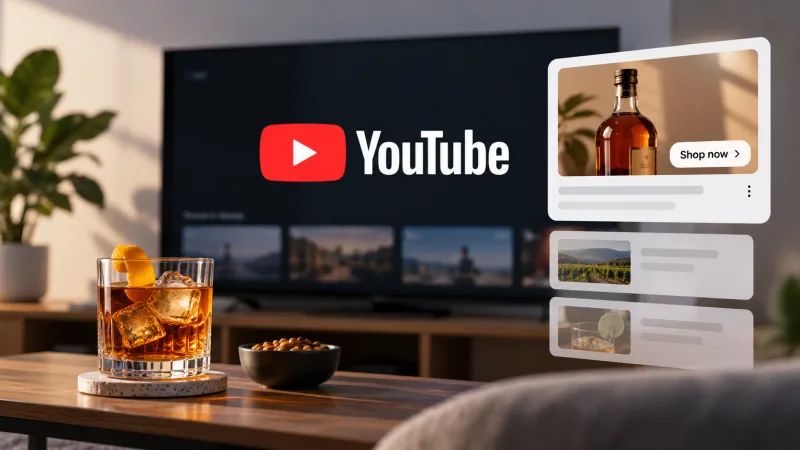
Google will allow alcohol advertisers to use personalized ads on YouTube starting October 30. The change applies only to markets where local law permits this format.
For brands, it means access to more precise campaign targeting. For marketers and arbitrage teams, new questions arise: which data can be used, how to verify GEO restrictions, and where the line falls between permitted targeting and legal violation.
What changes in Google's rules
This concerns personalized alcohol advertising on YouTube specifically. The platform will be able to show ads based on audience characteristics and interests in countries and regions where such practice is not prohibited.
The launch date is set for October 30. The permission is not global. It applies only where alcohol promotion through personalized ad mechanics complies with local regulations.
This is an important caveat for international teams. The same campaign may face different requirements depending on GEO. Settings that pass review in one country cannot be automatically transferred to another.
Why it matters for the ad market
Personalization changes the way traffic is bought. Instead of showing one message to a large audience, the advertiser gains the ability to divide users by set parameters and adapt communication to different segments.
For alcohol brands, this approach may provide more control over placements. Teams will be able to separately assess different audience reactions, compare CTR, and see how campaign results change depending on chosen settings.
Personalization itself does not override alcohol advertising requirements. It concerns the method of audience selection, not the content of the law. If age or other restrictions apply in a specific GEO, they must be accounted for before campaign launch.
What advertisers should watch for
First step before launching a campaign: verify legislation for each market. Determining the country of display at account level is not enough. It is important to understand which rules apply to the specific product category, ad message, and platform used.
Second point: audience setup. Personalized advertising requires careful work with targeting parameters. The more precisely the team understands who sees the ad, the easier it becomes to assess results and find reasons for CTR or ROI drops.
Third question relates to creatives. Different segments can test separate copy and visual solutions, but each ad must pass review for compliance with Google requirements and local regulations. An error in the creative can stop a campaign even with correctly chosen GEO.
It is useful to separate processes in advance: verify ad permissibility in the country; set audience restrictions; prepare and moderate creatives; launch a test campaign; analyze CTR, conversions, and ROI; monitor changes in platform rules and legislation.
This order reduces the risk that a team buys traffic first and then discovers a legal or moderation problem.
What changes for affiliate teams
For traffic arbitrage, the news has limited application. The advertiser receives a new ad tool, but this does not mean automatic approval of any alcohol offers for promotion through YouTube.
Affiliate teams will need to verify several restriction levels at once: affiliate programme requirements, Google rules, YouTube conditions, and specific GEO regulations. If at least one of these levels prohibits the campaign, launch carries the risk of blocking or loss of ad budget.
Special attention should go to the 'offer — creative — audience' bundle. Results cannot be assessed only by CPA rate or expected payout. Even good ROI does not compensate for placement rule violations.
For tests, it is sensible to use separate campaigns by country and not mix data from different markets in one report. Legislative conditions differ, so an aggregate figure across several GEOs may hide a problem in one specific country.
How to assess results after launch
Personalized advertising requires more detailed analytics. CTR alone is not enough. It shows reaction to the ad but does not explain whether the chosen segment brings the needed result after the click.
Reports should separate data by GEO, audiences, and creatives. Then compare: CTR of different segments; user acquisition cost; post-click conversion; ROI or ROAS by individual campaigns; share of rejected ads and re-reviews.
Testing all parameters at once is not advisable. If the team changes audience, creative, and landing page on the same day, the reasons for results will remain unclear. It is better to fix baseline settings first, then change one block and compare data.
Short tests also require caution. Low impression volume may give a random picture, and abrupt setting changes will distort accumulated statistics. Scaling decisions should therefore be made after comparing several segments and creatives.
Restrictions that remain
Google's main condition stays the same: personalized alcohol advertising is available only where local legislation permits it. Launch geography depends not only on technical settings in the ad account.
Also, the fact of permission cannot be considered a guarantee of moderation approval. The ad, audience, and landing page must meet platform requirements. Rules may differ for different markets, so international advertisers need a separate check before each campaign.
For users, the change will be visible through more relevant ad messages. For brands, it is a new way to work with audiences. For agencies and affiliate teams, it is another zone where marketing tasks are closely tied to legal restrictions.
Practical takeaway for teams
Starting October 30, Google opens personalized alcohol advertising on YouTube in legally permitted markets. The advertiser's main task now is not to scale buying immediately, but to correctly determine permitted GEOs, audiences, and ad formats.
The working scheme looks like this: first verify local regulations, then cross-check with Google rules, then launch a small test and analyze metrics separately. This approach helps understand which settings produce results and which create unnecessary risk for the account and budget.
The change itself expands campaign possibilities but does not cancel control. In the alcohol vertical, personalization must go hand in hand with legislative verification and careful creative work.


