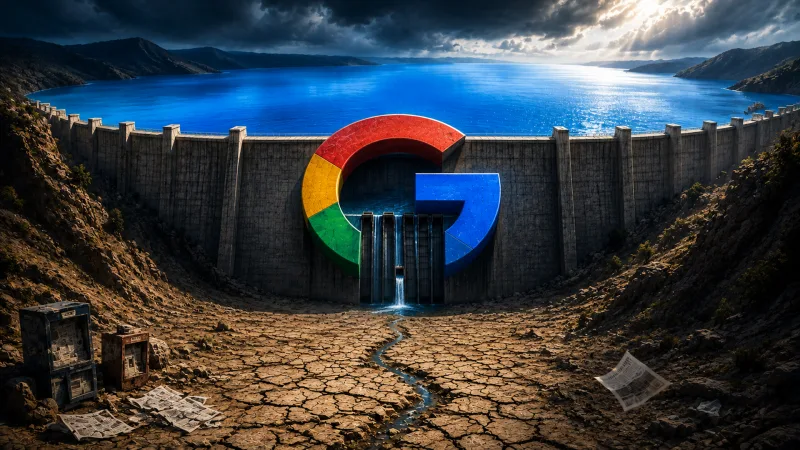
Around 300 French newspapers have filed a complaint against Google over AI Overviews, the generative answer blocks shown in search results. Publishers argue these summaries cut referral traffic and may violate agreements on compensating news organisations for content use. For the market this is more than another Big Tech clash. It signals that the organic traffic model is shifting faster than many SEO strategies can adapt.
Why the AI Overviews dispute matters beyond media
AI Overviews appear above standard organic results. A user asks a question, Google assembles a short answer from multiple sources. Sometimes links sit nearby, sometimes they fade into the background, and sometimes the user gets enough information without clicking through.
For publishers the problem is clear: they invest in newsrooms, fact-checking, SEO and infrastructure, while the search engine uses those materials to create an answer that may reduce clicks to the original source.
For affiliate and iGaming sites the logic is similar. If a user searches for 'best football betting sites', 'how to get no-deposit free spins', 'what is wagering in casinos', or 'CPA vs revshare for affiliates', Google can potentially deliver a short AI answer directly in the SERP. That means part of the informational traffic that used to flow to guides, reviews and FAQ pages may now stay inside search.
Zero-click is becoming the norm
SEO has long operated in a zero-click world: featured snippets, People Also Ask, maps, quick answers, calculators, news blocks. AI Overviews take that trend further.
The difference is that a classic featured snippet usually pulled a fragment from one site and gave it a visible link. A generative summary blends information from several sources and turns it into a new answer. The user sees an explanation, not a quote.
For sites this creates several risks. CTR can drop even when rankings hold. The brand behind the expertise fades while the user remembers Google's answer. Attribution becomes harder, and fewer visits mean fewer leads, registrations, FTDs and ad impressions.
In iGaming this hits particularly hard. Many affiliate projects build funnels through informational content that explains rules, bonuses, payment methods and terms. If the top of the funnel is consumed by AI output, the volume of users you can warm toward commercial action shrinks.
What French publishers are trying to protect
French media have already pushed Google on neighbouring rights, seeking compensation when platforms display news fragments, headlines and previews. With AI Overviews the argument goes deeper. Now the question is not just showing a snippet but creating a new answer based on someone else's content.
Google can argue that AI summaries help users and preserve links to sources. Publishers see it differently: if value is created by editorial work but traffic and attention stay with the platform, the economics of media break.
For the SEO market this is an important precedent. If regulators side with publishers, Google may be forced to show sources more transparently, expand compensation mechanisms, give sites more control over how content is used in AI answers, or change the AI Overviews interface so links receive more clicks.
But relying on regulators alone is risky. Businesses need to adapt now.
How AI Overviews can affect affiliate sites
For affiliate marketing the main question is simple: which pages will lose clicks first?
Content answering straightforward informational queries faces the greatest risk. Term definitions, basic instructions, short FAQs, generic guides without unique insight, summaries of bonus terms, and shallow vertical overviews are all vulnerable.
A page explaining 'what is revshare' can easily be absorbed into an AI answer. A piece comparing CPA and revshare for iGaming offers in Tier-2 GEOs with ROI calculations, case studies and traffic-buying experience is harder to replace.
Pages where the user needs to take action or compare options face less risk. Brand rankings with current terms, casino and bookmaker reviews with pros and cons, pages tailored to specific GEOs and payment methods, bonus and ROI calculators, case studies, comparison tables, and content with real screenshots and test data all fall into this category.
AI summarises well but struggles to replace practical verification, current figures, local context and author trust.
What SEO teams should do: practical checklist
1. Segment queries by click-loss risk
Gather top informational pages and assess whether the query can be answered in one paragraph, whether the page has unique data, whether there is commercial intent, whether the answer depends on GEO or date or brand, and whether the page includes interactive elements or tables that resist summarisation.
If a page gives a simple universal answer, it is at risk. Strengthen it or link it to deeper content.
2. Reinforce E-E-A-T with substance
Google is increasingly trying to distinguish retelling from experience. For iGaming and finance-adjacent topics this matters.
Add an author with clear expertise, update dates, ranking methodology, explanations of how brands were tested, screenshots of dashboards and bonus terms and payments, risk disclaimers, and local details for CIS, LATAM or Tier-2 and Tier-3 GEOs.
Saying 'we picked the best casinos' no longer works. You need criteria: licence, payout speed, limits, KYC, supported currencies, support quality, mobile version, wagering terms.
3. Build content that cannot be fully absorbed into an AI summary
A generative answer can restate a definition but struggles to replace a comparison table of 20 offers, a CPA and revshare calculator, an interactive GEO filter, a media-buying case study, regular bonus monitoring, or analysis of conversion changes after landing-page updates.
The more proprietary value, data and tools a piece contains, the lower the risk that a user will settle for an AI answer.
4. Work with branded demand
If all traffic comes from generic queries like 'best online casinos', dependence on Google is maximum. Branded queries are more resilient: the user is searching for a specific site, expert, ranking or service.
For affiliate projects this means developing a recognisable media name, publishing regular research, creating signature sections, building email or Telegram audiences where permitted, and launching useful tools under your own brand.
A brand is insurance against platform-controlled distribution.
Metrics worth revisiting now
Organic decline from AI Overviews can look subtle. Rankings stay stable, impressions grow, but clicks fall. So look beyond ranking.
Track CTR by query, especially informational ones. Monitor the share of zero-click in key clusters, the gap between impressions and clicks in Search Console, traffic drops on FAQ and glossary pages, conversion of informational traffic into commercial actions, changes in assisted conversions, and revenue per 1,000 organic visits.
For affiliates it is better to measure money: EPC, registration CR, FTD rate, ROI on content. Sometimes a page loses 30% of clicks but barely affects revenue. Other times a small FAQ cluster drop breaks the top of the funnel.
Legal trend: content is an asset again
The French complaint shows the market is entering a new phase: content owners will more actively defend their rights against AI platforms. This is not just about news. Reviews, databases, rankings, analysis and expert commentary are all raw material for generative systems.
For business the takeaway is simple: treat content as an asset, not a disposable SEO input. If you have unique research, an offer database, payout history, conversion data or A/B test results, that is a competitive advantage. Structure it, protect it, update it and use it across channels.
Closing yourself off from search engines entirely is a bad idea for most projects. But it makes sense to think through what data you put in the open index, how you mark authorship, where you create gated content, and which materials you use to build a direct audience.
Main takeaway for SEO and affiliate
AI Overviews will not kill SEO but will shift the distribution of value. Simple answers will more often stay in the SERP. Traffic will go to sites that offer more than a brief explanation: experience, comparison, timeliness, tools, trust and a strong brand.
French publishers are fighting for compensation and rules. SEO specialists and affiliate teams need to rebuild content strategy in parallel: fewer template texts, more proprietary data and practical value.
In the new search reality the winner is not the one who simply holds a position but the one whose value cannot be fully retold in a single AI block.


