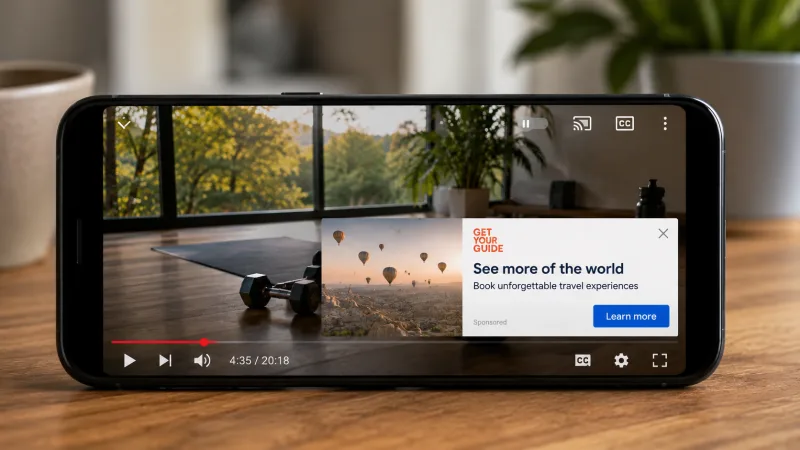
YouTube is testing static image ads that overlay videos during horizontal mobile playback. The format appears while users watch in landscape mode, creating a new ad placement that sits between display, video and native.
The test involves graphic ads shown during landscape viewing on mobile devices. Users have already rotated their screen and committed to focused playback when the overlay appears. YouTube has not disclosed targeting options, auction mechanics or how the format will integrate into Google Ads, but the direction is clear: more inventory without adding video interruptions.
Why horizontal mobile matters
Landscape viewing signals stronger intent than casual scrolling. The user turned the device, possibly entered fullscreen and expects to consume content longer. For performance teams that matters. The same creative can deliver different CTR and conversion depending on the moment it appears.
An overlay competes with content but does not stop playback entirely. If the creative is simple and relevant it can work as a fast trigger: bonus, match, promo, registration. For teams running betting, casino, sweepstakes or fantasy sports in approved markets, the format may be useful at the top and middle of the funnel, especially when the audience watches sports reviews, highlights, streams or entertainment content.
What works in a static overlay
Image ads require instant clarity. No 6-second narrative, no sound, no product demo. The creative must communicate in one or two seconds: one main message, large visual anchor, short CTA, clear benefit, minimal copy.
For a betting offer 'Free bet 1000 ₽ on match of the day' reads faster than 'Best odds, fast payouts, top events and convenient app'. For casino '100 FS after registration' usually beats abstract 'Play and win'.
Compliance is non-negotiable. YouTube and Google Ads enforce strict rules on gambling: licences, approved markets, correct wording, age restrictions, no guaranteed-win claims. Grey approaches that survive in push or teaser networks lead to fast bans here.
How to prepare creatives
Even if the placement is not widely available, teams can build a set of static creatives that work across Google Display and YouTube inventory. The approach is not 'draw a banner' but design a micro-message.
The creative should answer three questions without sound or context: what is offered, why it matters now, what to do next. Formula: offer plus benefit plus CTA.
Examples: 'Free bet on Champions League — claim in app', '100 FS for registration — activate bonus', 'Esports live — bet during the match', 'iGaming CPA network — payouts every week'.
For B2B affiliate offers test rational messages: 'Revshare up to 45%', 'Smartlink for Tier-2 markets', 'Exclusive betting offers CIS'. Keep it short.
Since the ad runs during landscape playback, compose for horizontal space. Do not rely on tall blocks or small elements. Place the focal point near centre without risking coverage of key video areas if the format has a fixed display zone.
Prepare several variants: minimalist banner with text and CTA, product creative showing the app, event-driven creative tied to a specific match or tournament, brand variant for retargeting.
Do not copy TikTok or Shorts creatives. Vertical video relies on hooks and dynamic editing. Static overlay demands clarity, contrast, large type. YouTube context is more sensitive to irritation: users came to watch a specific video, not browse an ad gallery.
What to test in media buying
If the format becomes available in Google Ads, evaluate it beyond CTR. Overlay ads may drive assisted conversions, especially in long funnels. For affiliate teams that is a problem: last-click attribution often undervalues upper touches.
Minimum metrics: CTR, CPC or CPM, conversion rate, CPA, ROAS or ROI, post-view conversions if available and properly configured, retention and LTV for gambling and subscription models.
Separate prospecting from retargeting. For cold audiences image overlay may be a cheap way to introduce the brand or bonus. For retargeting it reminds users who visited the landing page, opened the app or watched related videos.
In gambling especially useful segments: viewers of sports content, audiences by specific leagues and tournaments, in-market users if relevant categories are available, lookalikes based on depositors where permitted, remarketing to site visitors and incomplete registrations.
Risks: brand safety, compliance and user irritation
New ad formats nearly always face criticism. Users dislike ads that cover content. If YouTube scales overlay image ads, the platform will balance revenue against user experience.
Three key risks for advertisers. First, low contact quality. Users may see the banner but stay focused on the video, so high impression volume does not guarantee performance. Second, brand damage. Aggressive creative, loud promises, fake system buttons or intrusive design can harm perception. In betting and casino trust directly affects deposits. Third, moderation. Google is strict on financial, medical, gambling and adult categories.
For gambling teams verify before launch: is the product allowed in the chosen market, is there a local licence, are bonus terms stated correctly, are there no guaranteed-income promises, is 18-plus labelling present, does the landing page comply with ad policy.
If working through an agency account or MCC, discuss acceptable wording and categories with a Google representative early. An account ban from one test can cost more than all potential profit.
How affiliate teams fit the format into strategy
Do not treat image ads in YouTube as a replacement for video ads or search. It is an additional layer in the media mix. It can bridge reach and performance, especially when tied to remarketing.
Example chain for a betting offer: YouTube video ads to sports audience before a major match, image overlay with short promo 'Free bet on match of the day', remarketing in GDN and YouTube to landing page visitors, search campaign on branded and event queries, dedicated landing page for the match with fast registration flow.
For CPA networks and affiliate programmes the format may work as a B2B channel: attracting webmasters, media buyers, SEO site owners and Telegram channel operators. Creatives here should be concrete, not entertaining: CPA rates, revshare terms, markets, verticals, payout frequency.
Examples: 'iGaming CPA: offers for CIS and LATAM', 'Revshare up to 50% for SEO traffic', 'Exclusive betting offers for the season'.
Run such campaigns not to mass audiences but custom segments: queries about affiliate marketing, traffic arbitrage, CPA networks, betting affiliate programmes, SEO gambling and related terms.
Practical checklist before launch
If YouTube opens image overlay placement in the Google Ads interface, do not throw full budget at it just because it is new. Start with a controlled test.
What to prepare: five to ten static creatives with different messages, separate UTM tags for the placement, mobile-first landing page with fast load, clear post-click scenario, exclusions of irrelevant topics and channels, frequency cap if available, separate campaigns for prospecting and retargeting, stopping rules by CPA or ROAS, compliance check for each market.
Optimal test runs seven to fourteen days to collect data across different days of the week and times of day. For betting account for the event calendar: match of the day can sharply change CTR and conversion. For casino consider bonus periods, payday dates, holidays and local payment habits.
Takeaway
The image ad test during horizontal mobile playback shows where YouTube is heading: more native, less interruptive formats inside engaged viewing. For advertisers it is a chance to access new performance inventory, but only with proper creative adaptation and strict traffic quality control.
Affiliate and gambling teams should monitor the format launch, prepare static mobile-first creatives early and plan its role in the funnel. Winners will not be those who simply pour banners in, but those who combine YouTube context, clear offer, compliance and correct analytics.


