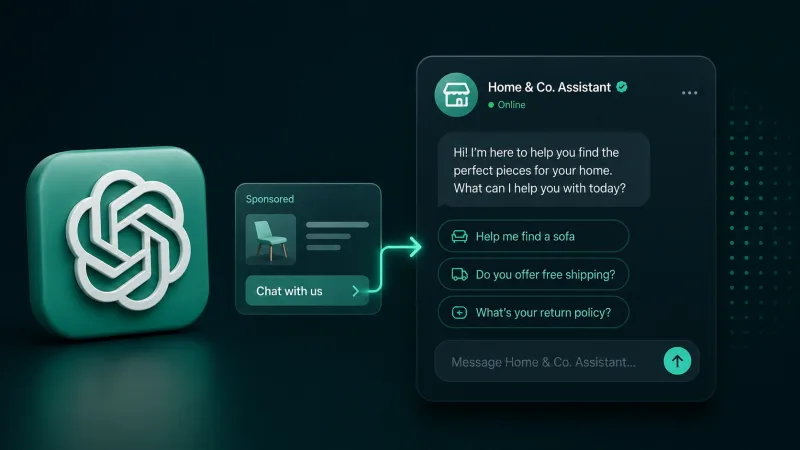
A click through to a landing page no longer looks like the only logical path. If a user asks a question in an AI chat, gets a recommendation and can immediately start a dialogue with a brand agent, the entire funnel compresses into a few messages. For performance marketing this is not just a new ad format but a potential shift in the conversion point: from landing page to conversation.
Ads no longer have to lead to a website
The classic digital advertising model was built around the click. A user sees an ad, goes to a landing page, reads the offer, submits a lead or leaves. SEO, PPC, CPA and affiliate marketing spent years optimising exactly this chain: impression → CTR → landing page → conversion.
Native advertising inside chatbots breaks that mechanic. Instead of sending the user to an external site, the ad can launch a dialogue with a company AI agent. That agent answers questions, clarifies needs, selects a product, helps complete an order or application.
For a business this means that part of the functions of a landing page, FAQ, sales manager and chatbot merge into one interface. For the user the path gets shorter: they do not change tabs, do not study a long page and do not search for an action button.
In B2B, fintech, SaaS and iGaming this is especially important because decisions often depend on details: GEO, budget, payment model, limits, KYC conditions, deposit methods, available verticals or type of traffic. An AI agent can establish these parameters in dialogue faster than a static landing page.
Why this matters for arbitrage and affiliate marketing
In affiliate marketing any new point of contact with a user quickly becomes a source of competition. If AI search and chat interfaces start showing commercial recommendations with the ability to talk to the brand immediately, the familiar role of pre-landers and landing pages will change.
Affiliates are used to controlling the creative, pre-lander, chain, analytics and traffic handover to the offer. In chatbot-native ads part of that control may shift to the platform and advertiser. The user interacts not with the webmaster's site but with an AI environment where the brand agent handles objections and leads to the target action.
This creates several practical consequences. CTR stops being the main indicator of interest; what matters more is the share of users who started a dialogue, depth of engagement and quality of intent. Conversion depends on the agent's script. Even a good offer can be lost if the AI qualifies the user poorly or gives overly generic answers. Attribution becomes more complex: you need to understand who captured value — platform, advertiser, partner, agent or all together. Pre-landers may become conversational, with interactive question-and-answer chains replacing long warming text.
For arbitrageurs this is not a reason to abandon classic funnels. But it is already worth thinking how to adapt approaches to creatives, sales scripts and analytics for dialogue interfaces.
What a funnel with an AI agent might look like
Imagine an iGaming scenario for a legal GEO. A user asks an AI assistant: 'Which bookmakers offer fast card withdrawals and a decent beginner bonus?' Instead of a list of links they see a sponsored recommendation and a button to start a chat with the brand agent.
The agent then clarifies the user's country and product availability, sport or casino vertical of interest, preferred payment method, user experience and bonus expectations, whether a mobile app is needed. After that the agent offers a relevant deal, explains the bonus conditions in plain language and moves the user to registration. That funnel is closer to the work of a good manager than a standard banner.
In a CPA model this can raise lead quality: the user already got answers to key questions before registration. In a revshare model the value is even higher because the agent can bring the first deposit and shape expectations that affect retention.
But there is also risk: if the agent promises too much, misinterprets bonus conditions or fails to account for GEO restrictions, the advertiser gets complaints, cancellations, compliance problems and ROI drop.
What to optimise instead of a standard landing page
If an ad launches an AI dialogue, a marketer will need to work not only with the headline and creative but with the logic of the conversation. In effect a new object of optimisation appears: the conversation funnel.
Key elements of that funnel include user intent — AI ads should hit queries with commercial or pre-commercial intent. The first agent response has a few seconds to confirm relevance; it should not begin with a long brand presentation but immediately clarify the task or offer a short choice: GEO, budget, format, payment model. Qualification is critical for B2B and affiliate verticals to quickly separate target users from random ones. A CPA network can ask about vertical, traffic volume, sources, experience, team presence. The final step should be simple: registration, application, demo booking, login, manager contact. The more actions after dialogue, the steeper the conversion drop. Promise control is essential: the AI agent cannot improvise in sensitive zones like bonus conditions, payments, restrictions, income guarantees, legal wording. For iGaming, fintech and nutra this is critical. Scripts must rely on a verified knowledge base, not free generation.
How this will affect SEO
SEO is also changing. If a user gets an answer and commercial offer inside an AI interface, the organic site visit may not happen. That means the fight is no longer just for search positions but for presence in AI responses.
For brands this amplifies the importance of structured content, expertise and clear entities: who you are, what you offer, which GEOs you work in, what conditions apply, how you differ from competitors. AI systems find it easier to use information if it is clearly formatted, consistent and backed by external sources.
In practice this means updating product and offer pages so conditions are unambiguous; using schema markup where appropriate; building brand mentions on industry platforms; monitoring how AI tools describe your product; preparing content for comparisons, selection scenarios and common questions.
For affiliate projects this is also a signal: sites that simply restate obvious facts will lose value. Winners will be those who provide comparisons, tests, real limitations, GEO nuances and practical experience.
Risks: attribution, compliance and data control
The main problem with chatbot-native ads is transparency. In classic performance advertising you can track clicks, UTM, postback, registration, deposit, LTV. In a dialogue environment the user path is more complex: part of the interaction happens inside the platform, part at the advertiser, part may not be passed to the partner at all.
CPA networks and advertisers will need to agree attribution rules in advance. For example, does a started dialogue count as a lead? How is the source recorded if the user returns after a few days? Who is responsible for incorrect agent answers? Can dialogue data be used for retargeting?
Compliance is no less important. In iGaming and financial verticals the AI agent must account for age restrictions, prohibited GEOs, local advertising requirements, responsible gaming rules and bonus wording. A mistake in one message can cost more than a failed banner.
A separate question is data quality. The better the agent knows the product, the higher the conversion. But if the knowledge base is outdated, the agent will scale errors. Marketing, sales and compliance will have to work together rather than leaving the AI agent to the technical team.
What marketers should do now
Waiting for mass rollout of these formats is optional. Preparation is possible in advance using tools already available.
First, describe current funnels as dialogues. Take an offer landing page and list the questions a user asks before converting: 'Can I run Facebook traffic?', 'Which GEOs do you accept?', 'What is the hold?', 'Are there caps?', 'How fast are payouts?' This is the foundation of a future AI script.
Second, test chatbots on your own properties. Even a simple bot with rigid logic will help understand which questions actually affect conversion and where users drop off.
Third, reconsider KPIs. Besides CTR and CPA, measure dialogue start rate, completion rate, share of qualified leads, average messages to target action, ROAS by scenario.
Fourth, prepare content for AI ecosystems. The clearer and more structured your product is described in open sources, the higher the chance AI systems will interpret it correctly.
Fifth, define zones in advance where the agent has no right to improvise. Bonuses, payouts, legal restrictions, profitability, medical or financial promises must be tightly controlled.
Conclusion
Advertising that launches an AI agent instead of a site visit may become one of the most visible shifts in performance marketing. It shortens the user path, makes communication personal and moves part of sales inside the chat interface.
For advertisers this is a chance to raise conversion and lead quality. For affiliates it is a challenge to the familiar role of landing pages and pre-landers. For SEO specialists it is another argument to develop brand, expertise and structured content that is clear not only to people but to AI systems.
Winners will not be those who simply add chat for fashion but those who learn to design dialogue as a full performance funnel: with clear intent, precise qualification, honest promises and measurable impact on ROI.


