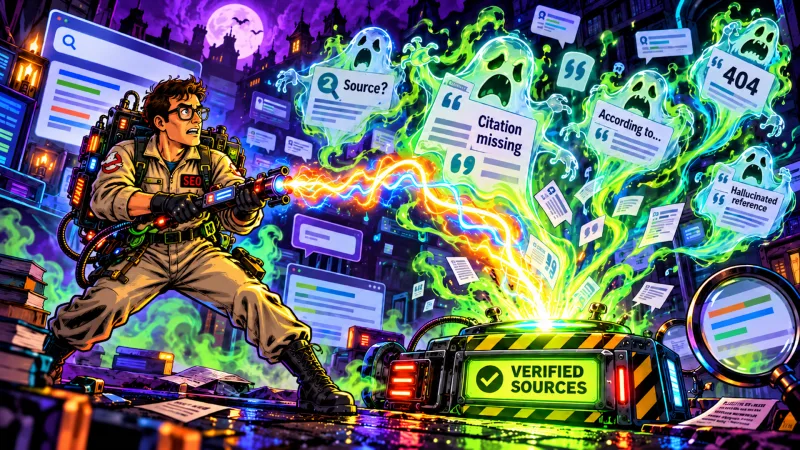
What a ghost citation is
AI search pulls fragments of your content to build an answer and then skips your brand name when presenting it. The user gets the information; you get neither the click nor the mention. The content did the work, but the traffic and recognition went nowhere.
The mechanics are straightforward. A language model assembles a response from retrieved fragments and attaches attribution — site name, link — as a separate step. The two do not always line up. So the fact that your text fed the answer guarantees nothing.
Why this hits harder than a rankings drop
A classic search result returns a click. An AI answer absorbs the query entirely. If your brand is not named, you have not lost a position — you have lost the contact.
For affiliate projects the consequence is direct: no mention means no click on the affiliate link, no registration, no revshare. The content performs; the conversions do not come.
Finding where you are cited without credit
The check is on answers, not positions.
Run the queries your content answers directly — 'how to choose an offer', 'what is revshare', 'how much does traffic cost in a vertical'. Feed them into AI search and look for your own phrasing in the response without a source attached.
Then search the answers for constructions that exist only in your text: your list structure, your order of arguments, your specific examples. Near-verbatim match with no name attached is a ghost citation.
Watch your traffic logs too. A spike in visits with an unusual referrer alongside a drop in ordinary organic transitions suggests the answer was built from your content, but not everyone followed through to click.
What to fix first
Do not touch the whole site. Prioritise pages that already answer specific questions.
Models are poor at pulling a brand name from a header or footer. If you need the name in the answer, it has to appear in the body of the fragment, next to the claim it supports.
Write paragraphs that hold meaning on their own. A block that makes sense out of context gets picked up more often than one that refers back to an earlier section. Each paragraph should carry its point without the rest of the article.
Short definitions, lists, and explicit question headings raise the chance that a model lifts your fragment verbatim — and carries the surrounding context with it. That is not a guarantee of attribution, but it improves the odds.
Attribution has to be built in
AI search is under no obligation to cite sources. The task is not to ask for a link; it is to make the brand name impossible to cut without losing meaning.
An offer comparison that names whose analysis it is, or data tied directly to a source — if the sentence breaks without the brand, the model tends to leave it intact.
What to do this week
Take five pages that answer audience queries directly. Run them through AI search and note where your text appears without your name. Add the brand to the key paragraphs and break the text into self-contained blocks. Recheck after edits — that is the only way to know whether attribution came back.
The right question is no longer 'is this page indexed'. It is 'does the brand appear in the finished answer'. If it does not, rewrite the fragments rather than wait for the engine to add the link on its own.


