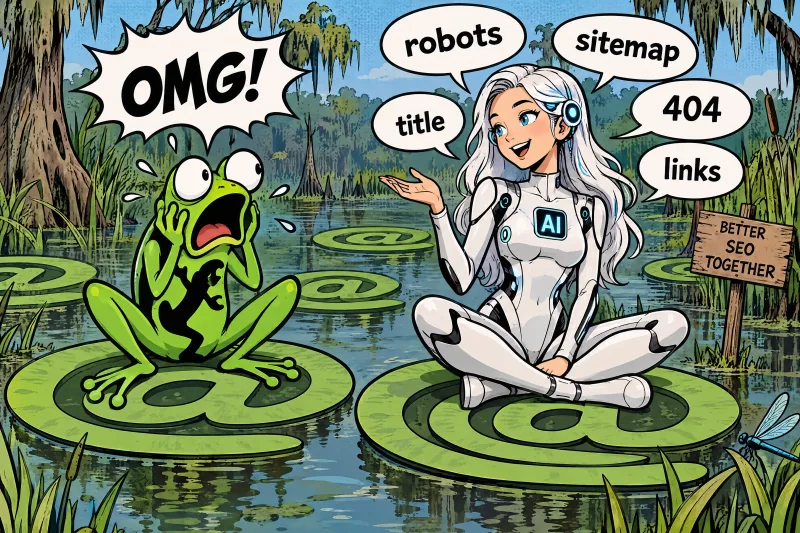
Most SEO professionals treat language models as content generators. Technical audits remain the domain of Screaming Frog and similar software because LLMs lack crawlers. The technical objection is valid—models have no network engine, cannot traverse site trees or handle protocols in real time. But the conclusion drawn from that fact is several years out of date.
The confusion stems from conflating two levels. No one is asking GPT to parse robots.txt manually. The task is different: offload data collection to external tools and leave the model to plan the route, make decisions at forks, and interpret what the tools return. This is called agent architecture. The model receives a set of functions through tool calling—a crawler, markup analyzer, indexation check, Search Console export. It decides the order to invoke them, what parameters to pass, and what to do with the result. It does not write code or crawl pages. It orchestrates the process.
What it automates
Agents handle tasks with a clear algorithm but no ready-made solution for the specific case. In technical audits, the model does not replace a full crawler but can manage one: set crawl depth, filter by status code, cross-reference with analytics data, flag critical issues. For semantic clustering, the model analyzes intent, SERP overlap, builds hierarchy, and proposes section structure rather than relying on manual grouping. Change monitoring becomes periodic checks of key pages, snapshot comparison, detection of missing markup or altered titles without notification.
The setup is not full automation. The agent executes routine steps; a human makes the final call.
Stack and limits
An SEO agent system has three layers. The tool layer holds crawlers, search engine APIs, HTML parsers, and XML sitemap libraries—each a function with defined inputs and outputs. The model layer receives the task, selects tools, passes parameters, and processes responses. The control layer ensures the agent does not enter an infinite loop, exceed request budgets, or return nonsense.
Agent architecture does not cover everything. Deep crawling of large sites—millions of pages—requires optimization at the network-request level, queue management, and parallelism. An agent only adds overhead. Low-level protocol work such as analyzing HTTP headers, server response time, or redirect chains remains faster and more accurate with specialized software. Tasks without a clear algorithm—those requiring expert judgment, intuition, or business context—fall outside the model's reach.
Practical position
Agent architecture does not replace the SEO specialist or classical software. It occupies the space between them, automating routine work that previously required manual effort but not deep expertise. For agencies handling dozens of projects, it speeds initial audits and monitoring. For teams running a single large site, it enables regular checks without writing scripts.
The key distinction is orchestration versus execution. The model should not do everything itself. It should know who to call.


