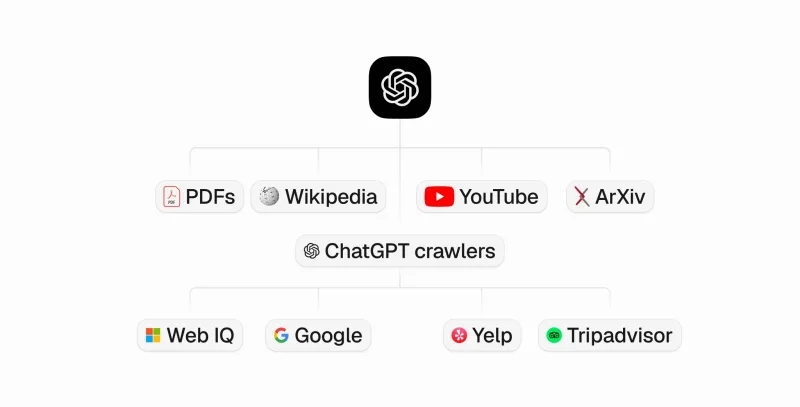
OpenAI has deployed its own search infrastructure under the code name Labrador. This is not a wrapper over third-party APIs — ChatGPT now indexes sites directly, builds its own rankings and aggregates data from multiple sources simultaneously.
For those working with organic traffic, this is a signal: visibility in ChatGPT is no longer a side effect of optimising for Google or Bing. A new channel with its own logic has emerged, and it cannot be ignored.
What Labrador is
Labrador is the internal name for OpenAI's search system. It runs in parallel with Bing and other provider integrations, but has its own crawler, index and ranking algorithms.
When a user asks a question in ChatGPT, the system can send a query to Bing or Google via API, access Labrador's own index, or combine results from several sources. The choice depends on query type, data freshness and source availability. For commercial topics, news and local queries, OpenAI increasingly relies on Labrador.
How this affects site visibility
Double indexing. Your site may rank in Google but be absent from ChatGPT answers — because Labrador does not index everything. Crawl budget is allocated differently, priorities are different.
Markup and structure matter more than text. Labrador parses structured data more aggressively than classic search engines. Schema.org, JSON-LD, clear heading hierarchy — not optional, but a baseline requirement.
Link equity works differently. Site authority in Labrador is built not from backlink count, but from citation frequency in model answers, mentions in authoritative sources and behavioural signals from ChatGPT users.
What to do now
Check robots.txt and access for the OAI crawler. OpenAI uses the User-Agent 'OAI-SearchBot'. If you blocked it earlier, reconsider the policy. Without crawler access, the site will not enter the Labrador index, even if it ranks in Google.
Add structured data. Article, Product, FAQPage, HowTo — markup that Labrador parses first. Without it, the site remains a black box from which the model extracts text blindly.
Optimise for direct answers. ChatGPT does not return ten blue links. It synthesises answers from fragments. To be included in such an answer, content must be fragmentable — short paragraphs, lists, tables; self-contained — each block holds a complete thought; and attributable — facts with sources, figures with context.
Track mentions in ChatGPT. There are no tools like Google Search Console for Labrador yet. But you can monitor brand and URL mentions in ChatGPT answers manually or via API. If a site is cited often, it strengthens its weight in the index.
Why this matters for arbitrage and affiliate
ChatGPT is traffic. Millions of queries per day, high audience engagement, low competition at launch. Those who optimise content for Labrador now will gain an advantage for a year or two ahead.
For affiliate, this is a chance to enter a new niche before competitors. Reviews, comparisons, guides — all actively used by ChatGPT in answers. If your content is structured correctly, it will become a source for thousands of dialogues.
For arbitrage, a new lead generation channel. ChatGPT users are already segmented by query intent. If the model cites your landing page in response to a commercial query, it is warm traffic with high conversion probability.
What comes next
Labrador is not an experiment. It is infrastructure into which OpenAI is pouring resources. Over time, dependence on Google and Bing will only decline.
Promotion strategy now includes three pillars: Google, social platforms and AI search engines. Ignoring the last means losing an audience that has already switched to ChatGPT as its primary information search tool.


