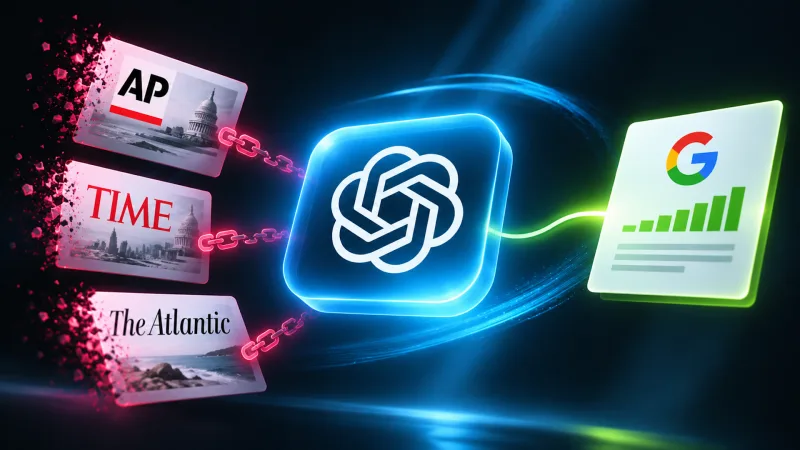
ChatGPT dropped citations to Associated Press, TIME, The Atlantic, TechCrunch and the Los Angeles Times by 50% to 90% within a week of July 9. No announcement came from OpenAI. Robots.txt remained untouched. Generative Pulse, which tracks over 40 million AI model responses, connected the drop to a pattern of citation losses tied to ChatGPT model launches throughout the year.
Journalism's share of ChatGPT citations fell from roughly 33% in January to 22% by September, in two distinct drops: April and July. Claude and Gemini left their journalism shares largely flat. On the same 102 prompts, ChatGPT rebalanced its sources toward government and NGO websites (10% to 35%) and brand sites (14% to 20%), away from news outlets. Citations remained within earned media overall; journalism lost ground to .gov domains and Wikipedia.
The July drop arrived with GPT-5.6's launch on July 9. Earlier drops matched earlier releases: Financial Times vanished by March 9, after GPT-5.4 Thinking launched March 5. The May wave preceded GPT-5.5 Instant becoming the default. Gemini's citations of these outlets barely moved. Google's impact came in May—TIME, TechCrunch, the LA Times and The Atlantic each lost 17% to 22% of top-three keyword rankings—but ChatGPT held those citations flat through June. Two search engines, separate timing, separate grudges.
GPT-5.6 Luna uses site: searches in 76% of its retrieval queries and retrieves 43% fewer sources than GPT-5.5. When Luna targets the largest domains, 75.9% of site: searches point to brand websites. If ChatGPT reads the FDA instead of the article about the FDA, newsrooms lose citations without any judgment on their journalism. This shift explains Reddit's share of ChatGPT citations falling 86% in four days mid-August, and listicles' share of retrieved pages nearly halving after GPT-5.6.
All outlets that ChatGPT cut this year—Financial Times, Wall Street Journal, Business Insider, The Verge, AP, TIME, The Atlantic—have announced OpenAI licensing deals. Reuters, CNBC, TechCrunch and the LA Times have not, and they fell too. A June OtterlyAI study found OpenAI licensees earned 48% more ChatGPT citations per page, before July 9. A licensing deal raises the floor; it does not prevent the drop.
Brand visibility in AI search rides on whether publishers make the model's reading list. Of 20,000 sites cited across four models, only 200 to 250 appear in all four. The same prompt asked twice on the same day generates overlapping cited domains only 41% of the time. Concentration on one publisher or one distribution channel becomes a liability when the model's priorities shift.


