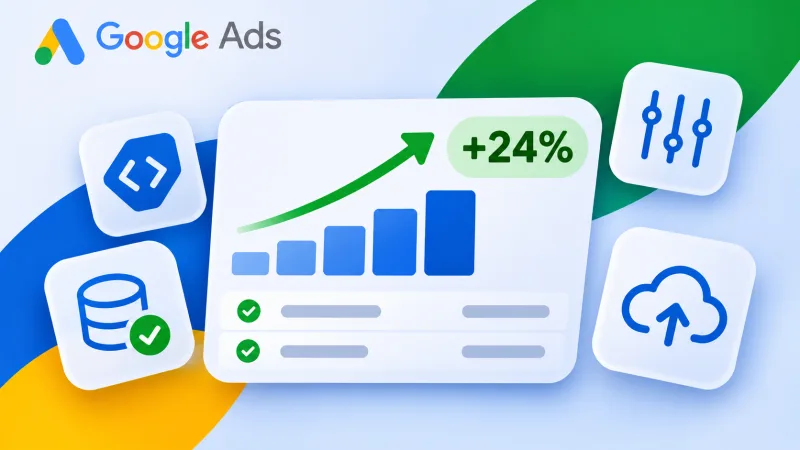
Google Ads has published Help Center documentation for its Data Strength Uplift metric, adding detail on how the figure is calculated, where to find it and which accounts qualify. The metric was first announced in September as part of Google's measurement updates.
What the metric shows
Data Strength Uplift estimates the percentage of additional conversions — observed and modeled — that an advertiser's first-party data setup captured over the previous 14 days. The displayed range runs from +1% to more than 50%, and the figure refreshes daily.
The metric covers contributions from enhanced conversions, Google tag gateway and Data Manager connections simultaneously. Where features overlap, Google deduplicates their contributions and produces a single uplift estimate rather than summing individual figures.
Eligible advertisers can find the metric under Goals → Conversions → Summary. Hovering over an Active conversion tracking status surfaces additional detail on how the first-party data setup affects measurement accuracy.
How the calculation works
Google compares an advertiser's current measurement setup against a baseline: a standard website tag for site conversions, and GCLID-only imports for offline conversions. The uplift is the difference between what the current setup captures and what that baseline would have captured.
One important distinction: the metric reflects measurement recovery, not proof of additional sales or leads. A reported uplift means Google's systems estimated more conversions were observed or modeled because of stronger signals — not that campaigns produced more customer actions. The metric does not affect conversion billing or Smart Bidding optimization.
Eligibility requirements
Not every advertiser will see the metric. Google's conditions include a minimum of 100 website conversions or 20 offline conversions in the previous 14 days, at least 30 days elapsed since adopting the eligible measurement feature, an Active conversion tracking status with no detected setup issues, an estimated uplift of +1% or higher, and use of supported first-party data features.
The rollout is phased, so some qualifying accounts may not see the metric yet.
Current limitations
The initial launch excludes Search Ads 360, imported Google Analytics conversions and Floodlight conversion actions. Conversion actions using only enhanced conversions for web — with or without other connections — are also outside the first wave; Google says support is planned for a future release.
If an advertiser's existing tracking already captures nearly all conversions, the estimated uplift may fall below the +1% threshold and not appear at all.
Google's recommendations
Google suggests a Connect, Match and Grow approach: connect first-party data sources through Data Manager, enable supported measurement features and improve the quality of consented customer signals. The specific recommendation is to pass at least three identifier signals per conversion event, covering ad interaction identifiers, customer information and transaction data. Conversion diagnostics within Google Ads can surface missing signals and configuration issues.


