What changed with GPT-6
ChatGPT now returns more than text. Responses include charts, fillable forms and interactive buttons. For site owners, that means a new touchpoint with users — and new uncertainty.
The unanswered question
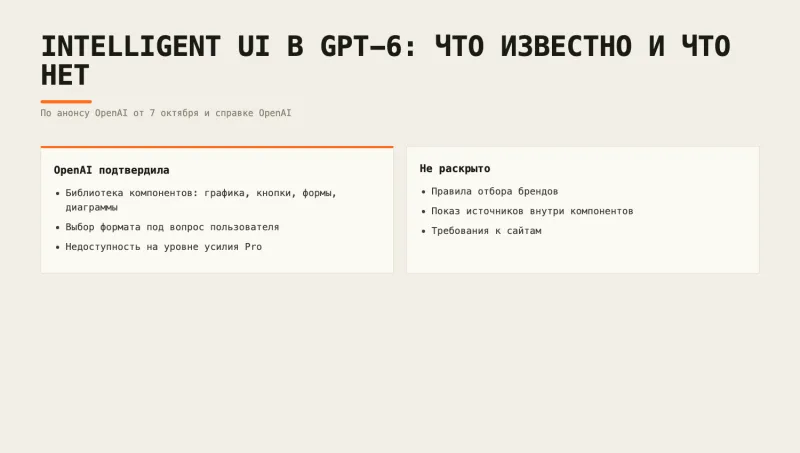
OpenAI published the announcement on 7 October. Technical documentation exists. SEO breakdowns appeared immediately. But the company has not disclosed how it selects which brands appear in the new interface elements.
That creates a problem. It is unclear what criteria ChatGPT uses to show a chart with data from a specific service or a form from a particular brand. Ranking logic remains hidden.
The structured-data theory
One hypothesis: sites with easily extractable structured information get priority. But that theory rests only on ChatGPT Shopping documentation — a product-card feature that worked before GPT-6 launched.
Product cards are a separate matter. They require schema.org markup, feeds, APIs. That mechanism is known. The question is whether the same requirements apply to charts and forms in standard ChatGPT responses.
What to check on your site
Even without clear rules from OpenAI, certain basics are worth maintaining:
Structured data — schema.org markup for products, articles, FAQ, organisations
Clean HTML — tables, lists and headings should be semantically correct
API availability — if the project has a public API, it may become a source for charts
Machine-readable content — JSON-LD, microdata, Open Graph
Each of these measures relates to known indexing mechanisms. They offer no guarantee of appearing in GPT-6 formats.
The difference between product cards and the rest
ChatGPT Shopping is a product with documented requirements. There is guidance on which fields to populate, how to pass prices, how to update stock.
Charts and forms in GPT-6 responses are different. They are part of answer generation, not a separate e-commerce module. Their appearance may be tied to the model's training data, real-time information access through plugins, or something else entirely.
What to do now
Check the technical foundation. Confirm that machines can read your site as well as humans can. Monitor updates from OpenAI — guidance will appear eventually.
Optimising for an unknown algorithm is pointless. But keeping parsing and data-extraction elements in order makes sense. Even if the rules change, structured content remains an advantage.


