ai-sdlc — плагин для Claude Code и Codex: что делает и как установить
Плагин ai-sdlc ведёт изменение по шести стадиям SDLC с человеческими гейтами: каждый шаг коммитит один Markdown-файл, а хуки не дают агенту обойти одобренный план.
MIT ★ 1 596 обновлён 2026-10-29
/plugin marketplace add hashgraph-online/awesome-codex-plugins
/plugin install ai-sdlc@awesome-codex-pluginsЧто делает ai-sdlc
Плагин разбивает работу на шесть стадий. Plan пишет intent.md, Design превращает принятый intent в spec.md, Build сначала проверяет plan.md и только потом трогает код, Test запускает настоящие проверки проекта и цитирует их вывод, Deploy прогоняет проходы из REVIEW.md и ждёт одобрения, Maintain следит за bands.yaml. После каждой стадии работа останавливается на человеке.
Внутри восемь скиллов, два субагента только для чтения (у них Read, Grep, Glob, Bash, без Write и Edit; на Codex ещё sandbox_mode = "read-only") и четыре хука. artifact-gate.sh не даёт писать в исходники, если этого не покрывает одобренный plan.md, и держит изменение, объявленное низкорисковым, подальше от чувствительных путей вроде CLAUDE.md и REVIEW.md.
Хуки молчат, пока в репозитории нет каталога .sdlc/, поэтому установка сама по себе ничего не меняет; .sdlc/OPTOUT выключает их и после инициализации. prod-guard.sh — вторая, более слабая линия: он спрашивает подтверждение на команды деплоя и удаления, но обойти его может тот, у кого уже есть shell. Настоящими контролями остаются IAM, branch protection и одобрения деплоя.
Какие задачи решает
- провести изменение от формулировки проблемы до деплоя с коммитом на каждом шаге
- запретить агенту правки в исходниках, которых нет в одобренном
plan.md - посмотреть, на каком гейте висит каждое незакрытое изменение
- поймать низкорисковое изменение, которое тянется к чувствительному файлу
- держать правила ревью и контрольные полосы в репозитории под git
Примеры запросов агенту
- Запусти
/ai-sdlc-initи подготовь репозиторий к работе /sdlc-planдобавь ограничение частоты запросов к публичному API- Покажи
/ai-sdlc-status: какие изменения и чьего одобрения ждут
Как установить ai-sdlc
Через маркетплейс плагинов
/plugin marketplace add hashgraph-online/awesome-codex-plugins/plugin install ai-sdlc@awesome-codex-pluginsПо шагам, с командами для каждой платформы: Плагины Claude Code: маркетплейсы, установка и как собрать свой
Вопросы об ai-sdlc
Как установить ai-sdlc в Claude Code?
Сначала добавьте маркетплейс: /plugin marketplace add hashgraph-online/awesome-codex-plugins. Потом поставьте сам плагин: /plugin install ai-sdlc@awesome-codex-plugins. В репозитории после этого выполните /ai-sdlc-init.
Что делает ai-sdlc?
Проводит изменение через шесть стадий: Plan, Design, Build, Test, Deploy, Maintain. Каждая оставляет один Markdown-артефакт и останавливается на решении человека, а хуки поддерживают эти гейты на уровне вызовов инструментов.
Нужен ли каталог .sdlc/, чтобы хуки заработали?
Да. Все четыре хука завершаются сразу, если в репозитории нет .sdlc/, а создаёт его /ai-sdlc-init. Файл .sdlc/OPTOUT отключает их и после инициализации.
Исходный текст
ai-native-sdlc · MIT
# ai-sdlc A six-stage software development lifecycle for coding agents, where every stage commits one Markdown artifact and stops at a human gate. Plan writes `intent.md` — the problem and the outcome, from an interview with whoever asked. Design turns an accepted intent into `spec.md`. Build reviews and then implements `plan.md`. Test runs the project's real checks and quotes their output rather than claiming they passed. Deploy runs the review passes and posts ranked findings for a human to approve. Maintain watches control bands and files the next intent when one breaks. Nothing here replaces judgment. Agents do the synthesis, the implementation, the verification and the triage; a person decides what to build, what risk to accept and what ships. Git records who asked, what the agent produced and who approved.  A person called that change low-risk, so it skipped the intent and spec stages. Then the agent reached for `REVIEW.md` — the file that defines what it may touch — and a hook stopped it. A declaration buys fewer stages, never fewer boundaries. 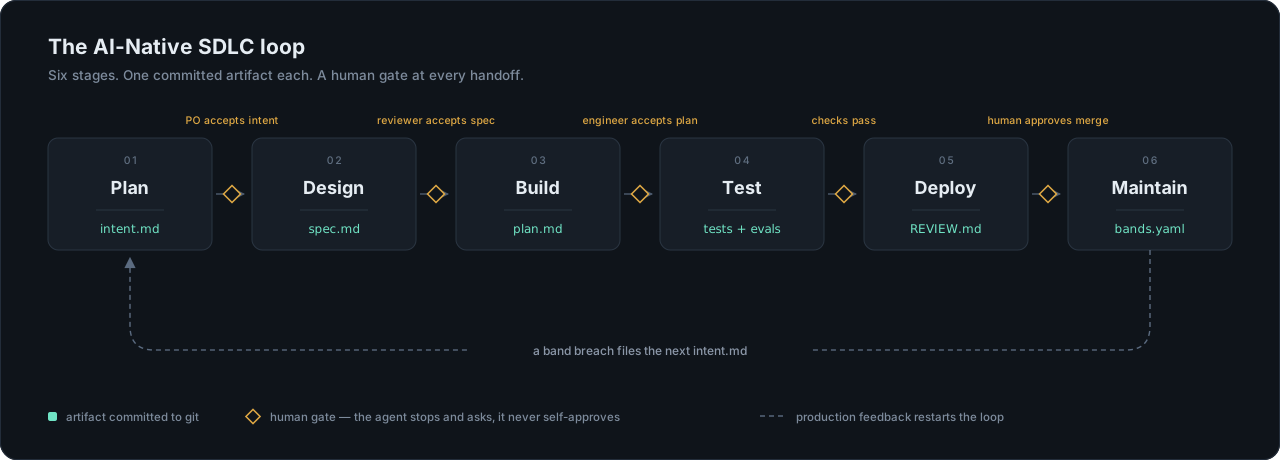 ## Install ``` /plugin install ai-sdlc --marketplace ghiaog123/ai-native-sdlc ``` Then run `/ai-sdlc-init` in a repository to scaffold it. ## Usage ### Start a change ``` /sdlc-plan add rate limiting to the public API ``` Plan interviews you about the problem — what users cannot do today, who is affected, what the constraints are — and writes `.sdlc/rate-limit/intent.md`. It stops there and waits for you to accept it. It will not choose an architecture. Then walk the stages. Each one reads the artifact the last one committed, writes its own, and stops: ``` /sdlc-design # accepted intent.md -> spec.md /sdlc-build # accepted spec.md -> reviewed plan.md, then code /sdlc-test # runs the project's real checks, quotes the output /sdlc-deploy # review passes, ranked findings, stops for your approval /sdlc-maintain # watches bands.yaml, files the next intent on a breach ``` ### A low-risk change A typo fix does not need an interview. Tell `/sdlc-plan` the change is low-risk and it checks your `REVIEW.md` sensitive-path list, then hands the change straight to `/sdlc-build` to enter at the plan. The stages are skipped; the gates are not. If the change turns out to touch a sensitive path, the agent refuses the fast path, and `artifact-gate.sh` refuses the write even if the agent tries anyway. ### Find out where everything stands ``` /ai-sdlc-status ``` One line per in-flight change: the furthest stage reached, whether its artifacts are committed, and which person the next gate is waiting on. ### Set a repository up ``` /ai-sdlc-init ``` Creates `.sdlc/`, writes project memory from the repository's real build, test and lint commands — `CLAUDE.md` for Claude Code, `AGENTS.md` for Codex — and installs the `REVIEW.md` and `bands.yaml` policy templates. Safe to re-run. ### Try the gate without installing anything ```bash git clone https://github.com/ghiaog123/ai-native-sdlc cd ai-native-sdlc export GATE="$PWD/plugins/ai-sdlc/hooks/artifact-gate.sh" source docs/demo-setup.sh gate README.md # exit 0, the plan covers it gate REVIEW.md # exit 2, the fast path cannot reach a sensitive path ``` That is the recording above, reproduced in a throwaway repository under `$TMPDIR`. ## What it installs Eight skills: the six stages, plus `/ai-sdlc-init` to scaffold a repository and `/ai-sdlc-status` to report which changes are waiting on which person. Two read-only subagents: a pull-request reviewer that applies the project's `REVIEW.md`, and a diagnostician that investigates a control-band breach without touching production. Four hooks, all of them inert unless the repository has a `.sdlc/` directory, so installing this plugin changes nothing until a project opts in: - `artifact-gate.sh` refuses a source write that no approved `plan.md` covers, and keeps a change declared low-risk away from governance-sensitive paths such as `CLAUDE.md`, `REVIEW.md` and CI workflow files. - `prod-guard.sh` asks for explicit human authorization on deploy and teardown command shapes. It is a second, weaker line — IAM, branch protection and deploy approvals remain the real controls. - `session-context.sh` and `prompt-nudge.sh` report where each in-flight change sits, derived from committed artifacts rather than stored state. Templates for every artifact the loop produces, including `REVIEW.md` and `bands.yaml`. ## What it intercepts, and why This plugin registers hooks, so it sees tool calls. Here is every one of them. | Hook | Fires on | What it does | Can it block? | | --- | --- | --- | --- | | `artifact-gate.sh` | `Write`, `Edit` | Reads the target path and the committed `plan.md` files under `.sdlc/`. Refuses a source write that no approved plan covers, and refuses any sensitive path while a fast-path change is active. | Yes | | `prod-guard.sh` | `Bash` | Matches the command against known deploy and teardown shapes and asks for explicit human authorization before those run. | Yes | | `session-context.sh` | Session start | Prints which changes are in flight and which gate each is waiting on. | No | | `prompt-nudge.sh` | Prompt submit | Prints the same one-line status. | No | All four read the repository and write nothing. They make no network calls. Every one of them exits immediately unless the repository has a `.sdlc/` directory, so installing this plugin changes nothing until a project opts in — and `.sdlc/OPTOUT` disables them even then. `prod-guard.sh` is a second, weaker line, not a sandbox. It matches command shapes and can be rewritten around by someone who already has shell access and intends to. IAM, RBAC, branch protection and deploy approvals remain the real controls. `SECURITY.md` says the same thing, and says which bypasses are worth reporting. ### Agent permissions Both subagents are read-only: `Read`, `Grep`, `Glob`, `Bash` — no `Write`, no `Edit`. On Codex they additionally run under `sandbox_mode = "read-only"`. They hold `Bash` because a reviewer that cannot run `git diff` and `git log` cannot review a change. They never edit a file, approve a pull request, merge, or claim a human gate has passed, and everything they read from a diff, a commit message or a dependency name is treated as data rather than instructions. ## What it does not do It never merges, never deploys, and never treats an agent's approval as a person's. It will not bypass branch protection, and it cannot: the gates it adds sit beside your existing controls rather than replacing them. ## Run the checks ```bash bash hooks/test-artifact-gate.sh bash hooks/test-sdlc-state.sh ``` ## Both runtimes The same source runs on Claude Code and on Codex. Agent definitions ship as `.md` and `.toml` kept in step, and project memory is written to `CLAUDE.md` or `AGENTS.md` from one template so the two cannot drift. Requires bash, git and python3. Nothing else. ## Documentation and license The method, the threat model behind each control, the metrics and how each one gets gamed, and a three-phase rollout are documented in the project repository at <https://github.com/ghiaog123/ai-native-sdlc>. This implements the method described in Anthropic's AI-Native SDLC playbook. It is an independent community implementation, not an Anthropic product, and is neither affiliated with nor endorsed by Anthropic. MIT licensed.
© Hieuvu7 · MIT · hashgraph-online/awesome-codex-plugins


